Main Site Navigation


 |
The Author
 |
More About This Author

 |
| |
|
In the spring of 2004, Robert Alexander took some time to talk with us
about some of his favorite books, authors, and interests.
What
was the book that most influenced your life or your career as a writer --
and why?
The book that had the most impact on my writing career was, I'm sure, John
LeCarré's The Spy Who Came in From the Cold. Not only does it convey a
remarkable idea with an economy of words, it's a vivid lesson in the
elements of any great book -- tension, pace, and plot. More precisely, from
it I learned that to write a book you not only have to have an original
idea, but also a compelling plot to propel that idea. When those two are
combined with equal force, you get a great book.
What are your favorite books, and what makes them special to you?
The Secret Life of Bees by Sue Monk Kidd is my favorite book in the last
five years. Not only did I love the atmosphere and the setting, I loved the
depth of humanity that emanated from every page as well as from the story
itself.
Middlesex by Jeffrey Eugenides is my favorite book in the last year. I mean,
how did that guy do it? It's so twisted and so wonderful. How could he write
a book about family incest and make it so compassionate, so sympathetic, and
even so entertaining? What a talented writer... if I'd attempted something
like that it would have been a real clunker.
By far and away Nicholas and Alexandra by Robert Massie had the biggest
impact on the course of my life because it set me on a track of all things
Russian. Soon thereafter I started studying Russian, which led to my
studying at Leningrad State University. That paved the way for my working
for the US government in the USSR. And it was while I was working in the
USSR that I was followed by the KGB, which gave me the idea for my first
published book. Because of that, I've often said that I owe my writing
career to the KGB. In truth, though it doesn't have such a zippy ring, I
suppose I owe my writing career to Robert Massie.
What probably put me more at peace than any other book was Janet Woititz's
Adult Children of Alcoholics. How come I didn't know any of this stuff when
I was a kid? How come the world didn't?
Back to Russia... I'm crazy about Edvard Radzinksky's book, The Last Tsar.
Not only did he bring together so many bits of information on the Romanovs,
he did it in such a Russian manner. And that's important because I think we
make a tremendous mistake in trying to understand Russia in a Western sense,
when in fact it's as much, if not more, Eastern.
And still in Russia... I love Ayn Rand's We The Living, which she said was
as close as she would ever write to an autobiography. It's tremendously
evocative of the chaos of the Russian Revolution. And in fact I like this
the best of all Rand's books because it's the least didactic. In other
words, the story delivers the point, rather than being hit over the head as
the reader is in some of her later works.
Anne Rice's Cry to Heaven is another book that I still carry with me. Set
during the time of Vivaldi and the castrati in Venice, it spins a
mesmerizing tale -- very evocative of the beauty and cruelty of life.
As for crime novels, I love the work of Michael Connelly, Ellen Hart, and I
particularly enjoyed Val McDermid's A Place of Execution. Books by these
authors always keep me engaged, curious, and, most important in the
mystery/thriller field, entertained.
Yikes, what else? Everything written by Hemingway, especially For Whom the
Bell Tolls. Steinbeck, too, of course; particularly The Grapes of Wrath.
Anna Karenina by Tolstoy.
Simply, I've always felt that for a book to work, it has to resonate for the
reader, it has to strike some familiar cord and perhaps, hopefully, shed a
light of understanding on the human condition. Either that, or it's just got
to help you escape, take you on a ride. And all of the above books have done
either or, in some cases, both for me.
What are some of your favorite films, and what makes them unforgettable
to you?
Oh, I'm terrible at this name stuff. I loved American Beauty because it
so deftly portrays the layers of truths that people keep. And I love epics
like Dr. Zhivago or, more recently, Indochine -- from them I took a better
scope of the human condition. Best in Show made me laugh and laugh and
forget about how many pages I had to write the next day. Conversely,
Adaptation is so good that it drove me crazy because I just kept thinking:
This is my life, I live this stuff, why do I need to watch it? I also loved
North by Northwest and Chinatown, of course, because they were both so
expertly structured.
What types of music do you like? Is there any particular kind you like to
listen to when you're writing?
Eighty beats a cycle. I don't know what that means, actually, but I know
it's the best for a writer to listen to while working. Bach's Goldberg
Variations is the prime example of that. I can put that on repeat, listen to
it for a month, and write and write. Without fail, it always makes me more
productive. My neighbors must think I'm crazy, but I have to have music that
I can't listen to. In other words, I'm always looking for music that creates
the "Highway Hypnosis" effect, something slightly repetitive, nothing too
engaging, yet always evocative -- in other words, music that makes the
checkbook side of my mind run screaming so that the creative side can step
forward.
If you had a book club, what would it be reading -- and why?
Oh, you don't want to hear this: I'd never have a book club. And I'd
never be in one. That's like working in a bank all day and coming home and
having an accounting club, or a chef being in a cooking club (well,
actually, that might be kind of fun), or an architect being in a club that
studies blueprints.
I've been in writing groups, which are spectacular -- we pass our
manuscripts around, talk, comment, critique. But that's work. In other
words, at a certain point you gotta give it a rest. Which is why I love
reading magazines and newspapers and going out for dinner and seeing movies
and taking walks. Sadly, writing has ruined my reading because I'm always
going, like, why did he break that paragraph there, why is she so good at
atmosphere, I would have done it this way or that way....
But, at the same time: I'm nothing without book clubs. I speak to them all
the time. And I love them. And I've been recommending The Secret Life of
Bees, Middlesex, and, well, a few obscure biographies on Rasputin (the last
of which doesn't get many takers). I recommend these books to book clubs
because their stories lingered long after I'd turned the last page.
If you could choose one new writer to be "discovered," who would it be --
and why?
Balzac. He's so old he's new again.
What are your favorite kinds of books to give -- and get -- as gifts?
Historicals, of course. Thrillers. Books on how to build stone walls.
Travel books. Cook books. I love books that both entertain and educate. And
I love to make stuff and figure everyone else does too. Actually, I think
the book I gave someone on stone walls was the only gift I've ever given
that has been regifted....
Do you have any special writing rituals? For example, what do you have on
your desk when you're writing?
I always have a cup of coffee on my desk and a dog on the floor. Also:
music that seems appropriate for that book and which I can stomach to listen
to for months, because I'll do exactly that, put it on repeat, day in, day
out. And it's gotta be nine o'clock, not earlier.
Many writers are hardly "overnight success" stories. How long did it take
for you to get where you are today? Any rejection-slip horror stories or
inspirational anecdotes?
I've been around the block so many times I'm dizzy. My first two books
are unpublished (which is a good thing), and I've worked with over fifteen
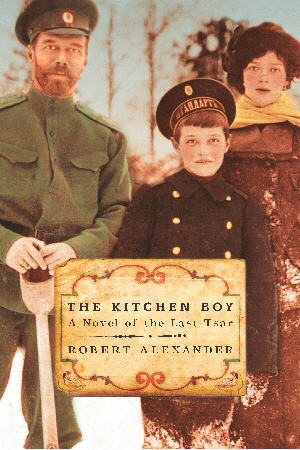
editors (which is a bad thing). The Kitchen Boy was literally twice as long
when I first sent it out -- and it was promptly turned down by 15
publishers. As soon as I cut out a mystery in the present and focused on
that amazing story in the past, it sold right away. I wish I could say it
only gets easier -- but the best thing I can say is that I've met a lot of
wonderful people along the way.
What tips or advice do you have for writers still looking to be
discovered?
Write for yourself. Draw from there, right from your heart. Of course,
if you want to be published you have to write something compelling, so don't
forget pace, plot, tension. You have to give the reader a reason to turn the
pages. But if you have the nerdy ability to finish what you start and the
compulsive ability to look at something and just keep asking "what if?" then
I'm sure you'll create something publishable.
|