Book Group Guide
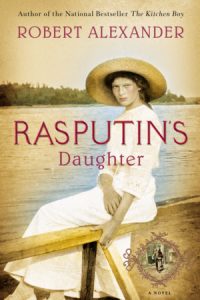
An introduction to RASPUTIN’S DAUGHTER
In St. Petersburg, Russia, in mid-December, the sun does not rise until ten, and it sets barely five hours later. In the waning days of 1916, all of Russia finds itself on the brink of a still more appalling darkness. The casualties of a disastrous war line the streets. As the wealthy savor their pastries and wines, the narod—the ordinary people—face starvation. In the palace of Tsar Nicholas, Aleksei, the hemophiliac heir to the throne, lies helpless as internal bleeding threatens his life. The once-mighty Romanov dynasty that has ruled Russia for three hundred years labors to stave off collapse.
In their struggle to save their son and their empire, the Tsar and Tsaritsa turn to an improbable savior, an illiterate monk with insatiable appetites for women and alcohol—and preternatural powers of prophecy and healing. The monk, Grigori Effimovich Rasputin, survives today as one of history’s strangest figures; his deeds and violent death have entered the realm of legend. Now, in a gripping novel of suspense, mysticism, and forbidden romance, Robert Alexander tells the story of an almost forgotten woman, Maria Rasputina, a willful, compassionate eighteen-year-old girl. To her, Rasputin is more than a baffling mixture of holiness and hedonism, more than the man who holds the fate of the Romanovs in his rough, unwashed hands. He is her father.
Alexander’s novel tells of the last week of Rasputin’s life, a time when, Maria says, she learned everything she knows about her father. Through Maria’s recollections, history’s mad monk emerges in a deftly drawn portrait, one in which saintliness and debauchery become almost impossible to distinguish. With sorrow and amazement, Maria recalls her father’s astonishing inner contradictions. She describes not only her father’s mysterious wisdom and uncanny clairvoyance, but also his naïve inability to comprehend the venomous political intrigues that surround him.
Yet Alexander’s most sensitive portrayal is of Maria herself. A girl on the threshold of womanhood, Maria discovers that the structures on which she most depends—her family, the Tsarist regime, her own spiritual sense of self—are rapidly giving way. In the midst of mounting chaos, she finds she must not only learn to understand her father but also to act decisively if she is to save his life. At the same time, she has to try to decipher the true intentions of a striking young man named Sasha whose behavior is either that of a love-struck admirer or a murderous stalker. Is he Maria’s only friend or her father’s most implacable enemy?
Finally and most bewildering, Maria must come to terms with the supernatural gift she has inherited from her father and resolve within herself the same dark struggle between good and evil that rages within her father’s soul. Just one outcome is certain: The events that will end this strife will be written in the blood of families and kings.

A Conversation with Robert Alexander
1. St. Petersburg, the setting of RASPUTIN’S DAUGHTER, is a city you know quite well. In your work, as in the work of many great Russian writers, it comes across as a curiously unreal place—a city that came into existence by a powerful act of will and still retains an aura of unnaturalness. What does St. Petersburg mean to you, both as an author and as someone who has walked its streets and known its people?
In 1703, Peter the Great commanded that an imperial city should rise out of the northern swamps, and it did indeed rise to become not simply his “little window” on Europe but one of the most majestic capitals of the world. With the Russian Revolution, that great city of the tsars sank like Atlantis, only to be replaced by another metropolis and another country—Leningrad, USSR. Then in 1991, the Soviet Union itself collapsed and sank, and the old city and country reemerged from the depths of history. So, yes, St. Petersburg is quite an unnatural place with quite a turbulent history. On the one hand it’s not very Russian at all, for it is a forced city of long, straight boulevards, while on the other it’s exceedingly Russian, for it was not only planned from the top down by an autocrat, but it is also a city of grandeur and excess—and Russians always take things to extremes.
I first went to Russia in 1976 as a student, and to me Leningrad/St. Petersburg represents that country’s long-held conflict with the West, for while it wants to be a great city on a par with any of the grand capitals of Europe, it is also determined to remain Russian in outlook and thought. Since the days of Peter the Great so many have hoped that St. Petersburg would finally provide a connection with the West and lead Russia to the well-being, prosperity, and peace she has been in search of and in need of for so very long. In its decay, I also see St. Petersburg as a tragic paradigm for loss. Thousands upon thousands of serfs perished in the construction of the capital, millions upon millions more during the revolution, Stalin, and the Siege of Leningrad (World War II), a combined loss that is nearly impossible to comprehend.2. You present Maria Rasputina’s story in the form of testimony given to a poet who has become an inquisitor in the Provisional Government. Why did you choose to present a poet as the instrument of revolutionary justice?
In actuality, many instigators of the revolution were the intelligentsia of Russia—her painters, authors, great thinkers, conductors, actors, and dancers—who hoped for a just government of and by the people. Russia was a great country in a great transition, moving from autocracy toward real democracy. So taken from my own writer’s point of view, who better to seek out the truth than a poet?
I should add, however, that the structure of the book developed from my research, which is quite common, for these things do take time to evolve. To begin with, I knew I wanted to write about Rasputin and use fiction to get to some kind of real truth of the man. And who knew him better than his eldest daughter, who loved him and lived with him right up until the end? However, the revolution happened for some very real and specific reasons, many of which swirled around Rasputin, so I knew I needed a foil for Maria. When I learned that Russia’s greatest poet of the time, Aleksander Blok, participated in the Thirteenth Section (the special commission set up to interrogate all those who knew Rasputin), I knew that was how I would tell the story, a loving daughter and a poet of the revolution searching for the truth of the man who had served as the revolution’s lightning rod.3. We expect the taking of testimony as a means of getting at truth. Taken as a whole, however, RASPUTIN’S DAUGHTER, like your previous novel about revolutionary Russia, The Kitchen Boy, raises questions about the accessibility and even the desirability of truth. Why do you suppose this theme has become recurrent in your writing?
Truth is always much more complicated than facts alone, and I’ve always been fascinated by the profound difference between spoken and unspoken truths. In terms of writing I believe that the structure of any good book plays upon this, the slow release of information as we inch toward the ultimate truth, or climax.
In terms of Russia, this theme is extraordinarily relevant, for Russia’s is a culture where its leaders—from the Romanov tsars to the red tsars—have always, always questioned the desirability of truth and found it necessary to control the accessibility to the truth in order to stay in power. Specifically, during tsarist days government censors controlled information to maintain the tsar’s godlike image (and therefore his autocratic, God-given power), and during Communist days the censors tightly controlled information to justify their political ideology and autocratic-like authority. When you think about it, both of these opposing types of government were eventually rendered bankrupt and overthrown by any number of simple truths.
For example, I was followed regularly by the KGB in 1978 when I was working for the U.S. government in the USSR One day, not knowing that I was tailed, I met with some friends and passed them several forbidden documents. These friends were picked up and taken in for questioning, and the regional authorities threatened to kick me out of the country for spreading propaganda. In a very real way the authorities were correct in their fear of what I had given my friends—a copy of Time magazine and an L. L. Bean catalogue—because in those simple pages were many little truths of what life was really like in the West.
And with that I should add that it’s my very strong belief that the Soviet Union collapsed not because we outspent them militarily or any such thing. Rather, the Soviets parted the iron curtain, and through this opening flowed ballet troupes, art exhibits, blue jeans, rock ’n’ roll, television programs, business exchanges, and so on, each of them carrying little truths that eventually grew into a great truth that no one could deny: The Soviet government was morally bankrupt and life was better in the West.4. The taking of testimony also typically leads to the rendering of a judgment. On one level, RASPUTIN’S DAUGHTER seems to invite us to pass judgment, but in another sense it challenges the capacity of anyone to judge another. Any thoughts?
If only the world could truly be divided into black and white, or good and evil, which would make everything so easy to understand. But that’s just not possible, there are so many shades of reality. When the Provisional Government formed the Thirteenth Section and interrogated everyone who knew Rasputin, they were hoping for definitive proof of many things—that Alexandra was a German spy, that Rasputin was sleeping with her, and so on—in order to render a definitive judgment on the reign of Nicholas and Alexandra. What they found, however, was that the royal couple had no end of good intentions (sadly, most of which were pathetically executed) and that the political system (autocracy) had outlived itself. Unable to come to a judgment that would both support and validate the revolution, which is what they were confident they would conclude, the findings of the Thirteenth Section were kept from the public. When the Bolsheviks seized power in the October putsch, the findings of the Thirteenth Section—some five hundred pages—essentially became a state secret because the truth of Nicholas and Alexandra by no means justified the violence that ensued. As such, the report of the Thirteenth Section was kept secret until it turned up at Sotheby’s auction house in 1995. Author Edvard Radzinsky, who was eventually given the report, has written an excellent book on this, The File on Rasputin.
5. One more question relating to this issue of judgment. We think of legal judgments as determining guilt and innocence. However, RASPUTIN’S DAUGHTER declines to present guilt and innocence as easily understood categories. Although Rasputin zealously debauches himself in your novel, you also suggest that he is a rare kind of innocent. He is, it seems, a victim of modernity, destroyed not so much by his own licentiousness as by his failure to fathom the evil that surrounds him. It sometimes seems as if the cynicism and perfidy of Rasputin’s environment have turned his trusting nature into a capital offense. In your view, is innocence absolute or relative? Does it even make sense to talk about innocence in the modern world?
More often than not I think innocence is relative and yet it absolutely makes sense to talk about it in terms of the modern world. Again, we’d all like the world to be defined in terms of good or evil and guilty or innocent so that we can more easily comprehend the world around us, but the reality of humankind is ever so much more complex.
In terms of Rasputin, I think politically he was definitely guilty of only one thing: his own pathetic judgment. Yes, he drank way too much, particularly toward the end. Yes, he was licentious and abused his great power, which he had accrued from his proximity to the throne. And, yes, he meddled where he shouldn’t have—can you imagine an uneducated peasant making cabinet post appointments based on his “visions”? But he wasn’t a traitor to the Germans, he didn’t sleep with the empress, and he truly believed that his actions, however inappropriate, were in the best interest of his beloved motherland.
Why, then, is Rasputin remembered as so dark and evil a figure? Because he was used by the enemies of Russia who sought to topple the monarchy.
Lenin quite correctly said that without Rasputin there would have been no revolution. To that, however, I would add that there would have been no revolution had Russia not been in the midst of World War I as well. The revolutionaries, seeking to overthrow the tsar, and the Germans, seeking to win the war, used Rasputin—often exaggerating his exploits—to demystify and de-deify the tsar. And once the tsar’s image was darkened and he was no longer seen as God’s representative on earth, revolution was all but inevitable. The spark that lit everything afire came when the Russian masses faced food shortages (caused by the war) and, politically speaking, there’s nothing more dangerous than a hungry peasant.6. Many of us who grew up during the Cold War have often found it easy to assume that the principal tension between Russia and the West was a matter of political theory: communism vs. capitalism. However, your novel reminds us that Russia’s uneasiness about Western influence has a much longer, more complicated history. Would you care to comment?
I think one of the greatest mistakes we make is trying to understand Russia in Occidental terms, whereas it is essentially an Oriental country. For example, my Russian friends insist that our lives are based on materialism, while theirs is based on spiritualism (when I pressed the issue, saying I’d never seen such voracious shoppers as Russians, my friends said they could simply walk away from their possessions, whereas they were sure an American could not). Political systems tend to take root in countries where the culture is able to accept it. I think capitalism took such rapid root in the United States because we were founded by independent immigrants seeking to better themselves individually. In Russia, it’s almost the reverse. Until 1861, 80 percent of the Russian population lived as serfs, the majority of whom lived in communes with their lives controlled from above by their masters. In other words, we in the United States value the capabilities of the individual for what he or she is able to contribute to society, whereas Russians value the sanctity of the collective (their “society”), which has historically taken care of the individual.7. We also tend to assume that the Romanovs were felled by the Bolshevik revolution. Some of your readers might be surprised to find that references to Bolshevism are essentially absent from your novel, that there was a post-tsarist government before Lenin, and that the ruling aristocracy in 1916 was deteriorating from within almost faster than any outside force could bring it down. What popular misconceptions about this period would you most like to dispel?
You know, Russia almost made it. The country almost transformed itself into an open, democratic society without dissolving into revolution and civil war. Had Nicholas II not been so rigid in his autocratic beliefs (which he enforced not for his own benefit, but because he truly believed that it was the best form of government for his beloved country), or had Kerensky been, oddly, more autocratic in those first few democratic months after the February Revolution, I think Russia would have made it safely through those tumultuous waters. But navigating a country through changing political times is an extraordinarily difficult thing to accomplish. Let’s not forget the Reign of Terror and the seventy-five years of instability that overcame France after her revolution.
There is no doubt that by 1916 Russia was a country long overdue for reform on many political and social fronts. While the Duma, the national assembly, had been established in 1905, its powers were limited; indeed, Nicholas II could have likely avoided the revolution had he simply granted the Duma the right to appoint cabinet positions. Dissatisfaction with both the Tsar and the war had taken a heavy toll on Russia, and when food riots broke out in February 1917, everything quickly fell apart. The Tsar, hoping to avoid bloodshed for his subjects, abdicated, and the Provisional Government, an alliance of liberals and socialists, quickly took power with the hope of creating a democratically elected government. But the problems facing Russia were too great, Lenin and his Bolsheviks too aggressive, and the Provisional Government was forcibly replaced by Lenin’s October Revolution, the first Communist revolution. So, of course, in 1917 Russia saw two revolutions, one that ousted the Tsar; the second that ousted any hopes of a democratic country.8. Rasputin’s reported healing powers raise uncomfortable questions for some people. If people believe that such powers exist, they are likely to associate them with some unique moral superiority on the part of the healer. People who want to reserve such abilities for saints and messiahs either have to reject Rasputin or seriously rethink their definition of sainthood. Do you find the stories of Rasputin’s healings believable, and how do you feel about the seemingly contradictory idea of the holy sinner?
This, of course, is one of the main issues of the end of the Romanov dynasty. The tsarevich (the heir to the throne) suffered from hemophilia; all the best doctors from around the world were called in, but none could help. Finally, and at last, one and only one person was found who could comfort the young boy and stem his attacks of bleeding. And that person was none other than Grigori Effimovich Rasputin. When the boy seemed doomed for death, Rasputin, time and again, in well-documented episodes, saved the boy. Understandably, Nicholas and Alexandra, who adored their son and who would do anything to save him, viewed Rasputin as a gift sent directly from God. But how did Rasputin do it?When discussing the issue of Rasputin’s powers, I prefer to look at this question first: How do people heal? Our primary method of healing in the West is via modern medicine. But there are, of course, many other ways to positively affect one’s health, perhaps none greater, in my opinion, than the relationship of the mind and body. In recent years much has been written about this—I’ve seen any number of articles on the way chronic stress can harm our hearts and even damage our immune system—but that’s only the beginning.
For example, take the story of George, who was known to be very nonjudgmental and very loving and also, most important, known for his healing abilities. One day he walked into a nursing home where he had an almost miraculous affect on many people. One woman, who hadn’t spoken in two weeks, beckoned him to her side and spoke in complete sentences. Another, who hadn’t gotten out of her wheelchair, rose to her feet and crossed the room just to meet him. Still another healed his partially paralyzed hand just by attempting to touch George. Indeed, one of the nurses noted that whenever George entered a room, everyone’s blood pressure dropped. And that came as no surprise, for George was a therapy dog that regularly visited children’s hospitals and nursing homes, bringing smiles and good health to all who met him.
So if a dog can have such a positive healing effect, why not Rasputin?
Personally, I don’t view Rasputin as either a saint or a devil by any means. I do think, however, that he had healing abilities if for no other reason than many people ferociously believed he did—and this belief in his powers in turn had a positive effect on their own ailments. Essentially, I view Rasputin as a man who drew strongly from the ancient shamanic traditions of his native Siberia (the word shaman is of Siberian origin) and who in turn combined them with his strong Christian beliefs. Through gentle touch, compassion, biting insight—even the rumor and innuendo spread by others—Rasputin was able to convince thousands that he could navigate between the physical and spiritual realms and heal where spiritless (and therefore morally bankrupt) Western medicine could not. He was, in essence, the placebo that was able to cure simply because the patient trusted him so strongly. Empress Alexandra believed in him so wholeheartedly that when Rasputin stated that the boy would survive a bleeding attack, she took his word as absolute. This, of course, calmed her tremendously, which in turn certainly calmed the ailing boy, thereby ridding the scene of mortal doom and panic. And there’s no question about what a positive effect that would have and did have on the boy’s blood pressure.
I don’t find any of this hard to believe, for I’m equally suggestible. Not long ago I went to the doctor with a horrible, horrible cough, certain I had come down with some exotic and dooming ailment. The doctor, whom I’ve long trusted, quickly told me that I’d be fine in a few days, all I needed was rest. Well, I left his office already feeling better, for he’d eliminated one of the greatest symptoms of my illness, my own anxiety.
When you think about it, Rasputin is another good example or even metaphor for Russia’s conflict between East and West, past and present.
9. In contrast to her sexually athletic father, Maria has only one object of romantic indiscretion. However, this one attraction, seemingly so much less damning than her father’s promiscuity, triggers a catastrophe. Why does she suffer so profoundly for her love?
Maria is young and just waking to the complexities of passion, so of course she suffers for Sasha, the first person outside her family to touch her heart. I clearly remember my first love and how pure and true and amazing it felt; when that relationship collapsed I was sure I would never love again. Such is both the naïveté of youth and the beautiful purity of it. Intertwine a youthful love story with the complexities of an aged society’s collapsing into chaos and you get not simply the dramatic power to move a story, but, one hopes, the dramatization of just how conflicted people were at the time and how incredibly much they lost.I’m crazy about using fiction to tell history because while we all need to know the facts of exactly what happened, fiction allows us to enter the hearts and minds of the people of that period, which in turn allows us to explore the emotions that, by and large, determined the facts. And actually, the irony of Maria—that everything she does to help her father only serves to quicken his destruction—is metaphoric of the revolution itself, for in trying to liberate its people from autocracy, those seeking a better country drove their beloved Russia into communism, one of the worst and most authoritative regimes the world has ever seen.
10. In narrating your story from Maria’s perspective, you take on a formidable challenge: thinking your way into the mind of an eighteen-year-old girl from a different time and culture. What was the greatest challenge for you in crafting Maria’s voice?
In writing this story from Maria’s point of view I broke my own cardinal rule—never create a main character as someone from a different country. To do that is very risky, I’ve always felt, because there are so many layers to capturing and understanding a different culture. While I’ve written a number of novels set in foreign countries, I’ve always used an American as the main character, as the “vehicle” or device, for looking into that country and trying to understand it. I’ve always felt it was presumptuous to do otherwise—to assume that I could capture the spirit of a different country. Indeed, I know European authors who have lived in the United States for fifteen years or more who still make small but exceedingly fundamental errors in writing about America.And while I skirted this issue in The Kitchen Boy by writing it from a Russian/American’s point of view (Misha is in many ways based on the many immigrants I’ve known), I certainly didn’t in my new book. But who else was closer to Rasputin, who else knew him better, who else loved him more than his own daughter? In the end, of course, all this is why I succumbed to writing the story of Rasputin’s last days through Maria’s eyes. And that was, then, the most challenging aspect of writing her character, writing accurately from a young Russian’s point of view during such a tumultuous period of history.
11. One aspect of Maria I found especially intriguing is her uncertain level of self-awareness. Although she is dealing with questions that are too large for an entire nation, let alone the daughter of a half-mad peasant, she has moments of brilliant insight. Yet we as readers see that there are troubled aspects of her own consciousness she has yet to confront. She is smart and endearing, but also horrifyingly troubled. How did you come to your understanding of what makes Maria tick?
The purpose of any main character is to carry the story by engaging the reader, inviting him into the book, and making him see and care about the events. In that sense, I made Maria a likable character and used her to turn the spotlight or camera on her father so that the reader could see Rasputin from Maria’s human (and not political) point of view.
My main goal in writing both The Kitchen Boy and RASPUTIN’S DAUGHTER was to write them with all the authority of an eyewitness, so I relied not only on the innumerable history books but also on the diaries and memoirs of the time for their level of detail. Of course gathering all these personal observations and intimate experiences is extraordinarily time consuming, but there’s no better way to create a sense of verisimilitude than by dropping in a particular type of shoe or that this character uses jam to sweeten her tea or even something like the color of wallpaper.Wanting to capture this sense, I found three books that Maria wrote, My Father (which appeared in the 1930s), Rasputin: The Man Behind the Myth (which she co-authored with Patte Barham), and finally Peasant to Palace, Rasputin’s Cookbook (written by Patte Barham from interviews with Maria). Of course, Maria’s personality and observations shone through all of these books, and to augment them and capture as much about the revolution as possible I used the many diaries and letters others wrote during those times. On top of that I used the advice and thoughts of my many Russian friends to try to create a thoroughly Russian voice. I also had the manuscript proofed in Russia to catch any Americanisms that I might have slipped in by mistake.
So while my main goal was to use the character of Maria as a way to understand her mythical father, Rasputin, I knew I wouldn’t succeed unless, of course, I created a realistic Maria.
12. Your novel asserts that one of the “facts” that most of us thought we knew about Rasputin, namely, his supernatural resistance to being killed, was largely a myth concocted by his assassins. What, as far as can be determined, is the real story of Rasputin’s death, and why are the misconceptions, if any, so durable?
I’m fascinated by the way stories are concocted and myths created to promote a political agenda, and there’s no more expedient a way to accomplish this than to focus on a single egregious soul. On top of that, there’s no quicker way to topple a king than to blacken his consort. Rasputin, of course, served that function, his often outrageous behavior used to soil the image of the Tsaritsa and the entire royal family, as well as to point out the inequities of the autocratic system, of which there were so many.So in 1916 you had, on the one hand, the revolutionaries who were quite effective in using Rasputin as “agit-prop” (the contraction of the Russian words agitatsiya and propaganda, meaning the way to stir up emotion and influence opinion), while on the other there was the vast majority of the aristocracy who clearly saw Rasputin as a threat to their very privileged lives. Ironically, it served both opposing sides to portray Rasputin as a holy devil. For the revolutionaries the image of a meddling deviant was reason enough for toppling the Tsar, while the aristocracy knew full well that the only way they could justify the murder of a peasant in cold blood was to portray him as an evildoer doing great damage to Holy Mother Russia.
So the story that Rasputin was supernatural and nearly impossible to kill is nothing less than a bunch of bunk, created for purely political reasons. It amazes me, too, how the myths just go on and on. Many still claim Rasputin was a giant of a man, yet if you examine historical photographs you will see he is not a big man at all, shorter even than the Tsaritsa herself. Yet another recent newspaper story claims that Rasputin’s supposed thirty-centimeter penis just went on display in St. Petersburg—which is impossible because Rasputin’s autopsy report, only recently found, makes no mention (as it certainly would) that he was dismembered.
No, Rasputin was quite human and quite mortal. After all, in 1914 Rasputin was very nearly killed by a small, ill woman who succeeded in stabbing him only once. Yet up until his death in the 1960s, Prince Yusupov maintained that first they had to poison Rasputin, then stab and shoot him, but Rasputin died only when they threw him in a river, whereupon he drowned. That last piece is very important, because at the time the Russian masses strongly believed that a person could not become a saint if he died by taking water into his lungs. So you see, by playing up the Rasputin-as-a-devil myth, Yusupov and the others were not only trying to justify the murder, but also making sure he would never be worshipped or canonized by the common people. That none of this information was revealed until recently is because Rasputin’s autopsy report and the transcripts of those who knew him all vanished.
Essentially, I believe Rasputin was murdered in cold blood by nobles very close to the throne, nobles who created the outrageous story of what it took to kill a so-called devil in order to prevent the masses from rebelling against the privileged aristocracy and the tsarist government.
13. The names of various Russian literary icons—Pushkin, Lermontov, Gogol, Tolstoy—surface periodically in RASPUTIN’S DAUGHTER. Maria lives her life with a deep consciousness of literature. How do you think this consciousness affects both her character and your own mode of storytelling?
Because of the censorship that has permeated their lives for so many centuries, Russians have long turned to the literary arts to explore ideas and thoughts suppressed by both the tsars and Communists alike. In fact, the four writers you mentioned are still renowned for their progressive thinking—Russia’s greatest poet, Pushkin, was committed to social reform; Lermontov claimed his poetry was “iron verse steeped in bitterness and hatred”; Gogol used satire to affect social criticism in Dead Souls; and of course Leo Tolstoy, called an anarchist by some, was both a vegetarian and a pacifist who saw the aristocracy as a burden to the poor.So Maria is attracted to literature for two separate reasons. First, Maria is just stepping into her womanhood, and poetry is like a flashlight to her, illuminating and making clear all that her newly awakened heart is searching for. Second, literature is feeding her consciousness, or informing it, with all the rights and wrongs not only of her father, but her country as well. And I used both of these things in my storytelling—literature to give Maria heart, and literature to give her soul.
Questions for Discussions
1. In Chapter Eight, Rasputin foresees that the River Neva will run red with blood. In what other ways does blood act as a dominant metaphor in RASPUTIN’S DAUGHTER?2. Rasputin’s lack of personal morality repels even his own daughter, yet he gives comfort to the royal family and saves the Tsarevich from dying. Is it fair or proper to demand good moral behavior from someone who uses his power to perform great good for others?
3. Maria is also sometimes disgusted when she observes that her father has the mannerisms and perceptions of a peasant. At the same time, however, the opinion is expressed in the novel that the narod, or the common people, must finally be the saviors of Russia. How do ideas of social class influence Alexander’s storytelling, Maria’s viewpoint, and, finally, Rasputin’s fate?
4. Maria suffers terrible anguish at the hands of Sasha, who repeatedly betrays her. But is Maria any less of a betrayer? How do her failures of loyalty contribute to the tragedies of the novel?
5. Given the largeness of her father’s character and influence, it seems inevitable that Maria should define herself in comparison with him. Are Maria and her father fundamentally alike or essentially different? What are their most significant points of similarity and difference?
6. Scandal breaks over the Romanovs because of the Tsaritsa’s decision to bring in Rasputin to help Aleksei. Yet the public does not know of Rasputin’s duties at the palace, let alone that the heir to the throne is suffering from hemophilia. Did the Tsaritsa make the correct decision in keeping this information essentially a state secret, and in doing so did she encourage or lessen gossip against her?
7. Although there is nothing ordinary about Maria’s father, many of the issues that arise between them are questions that might come up in any father-daughter relationship. How do the struggles between them reflect typical family tensions? In what ways do their quarrels differ from the ordinary?
8. As Rasputin gives aid to the apparently dying Tsarevich, Maria asserts that she has never seen such a blatant fight between good and evil. To what extent is the entire novel a dramatization of the battle between good and evil? How does Maria perceive the difference between the two? Is she always correct, and, if not, what accounts for her failures of perception?
9. In Alexander’s novel, how does Maria’s character seem to have been influenced by her heredity? What traits appear to be more the result of her upbringing? Does she have the kind of personality that one would expect from RASPUTIN’S DAUGHTER?
10. Food and eating are often mentioned in RASPUTIN’S DAUGHTER. Do these subjects have more than literal significance? How do we come to know Rasputin from what he eats and how he eats?
11. On one level, RASPUTIN’S DAUGHTER is about a young woman learning to understand and relate to her father. On another level, it is about Maria’s anxiety-ridden discovery of her sexuality. How do these two themes intertwine, and what are the results of their interaction?
12. How trustworthy do you find Maria as a narrator? How well does she understand the events that she recounts? Perhaps most significant, how fully conscious is she of her own wishes regarding her father?
13. What are the natures of guilt and innocence in RASPUTIN’S DAUGHTER? What feelings of guilt does Maria experience? How does she respond to them? Does she regard her father as ultimately guilty or innocent? Do you share her judgment?
About the Author
Robert Alexander is the pen name of R. D. Zimmerman. A graduate of Michigan State University, Mr. Alexander has also studied at Leningrad State University and has lived and traveled extensively in the former Soviet Union. His previous novel of revolutionary Russia, The Kitchen Boy, was a New York Times bestseller and received strong praise from critics and readers alike. Under his own name, Mr. Alexander has written numerous mystery novels, including Hostage, Outburst, and Innuendo: A Todd Mills Mystery. Robert Alexander currently makes his home in Minneapolis.