The Story Behind the Book
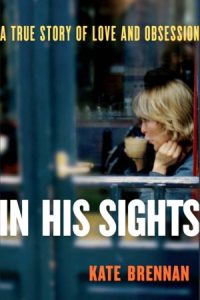
IN HIS SIGHTS by Kate Brennan
 “Was it cathartic?” That’s the most frequent question I hear now that I’ve finished writing In His Sights, the memoir which chronicles my experience as a stalking victim. The eyes behind the query generally share a common reflection: They’re looking for a yes.
I always disappoint. Though I take a few seconds each time to see if my answer has changed, it remains no.
In one way, being stalked is like being abused or being raped. In the aftermath, you are never the same. You never get over it. You may figure out a way to live through it, to survive it. You may even figure out a way to get on with your life, but you never drop your vigilance. You are never purged of the memories and never again will you feel entirely safe.
Somehow I knew that, so I didn’t expect writing my story to be cathartic – which, of course, begs an obvious question: Why write about the experience – and relive each terror and trauma in every step of the rewriting and editing – if it will not offer such relief?
In the moments, often stretching into days and weeks, when it would have been easier to stop writing, to stop remembering, a single thought kept me at my desk: Millions of people (mostly women) have lived, are living, or will live a version of my story. And most of them, not professional writers, do not have the ability to write their stories for publication.
I have had many advantages in life. I was born into a well-educated, articulate family and I had parents who provided each of their children with excellent educations, and helped and encouraged us to develop our natural gifts – in my case, writing and researching. They imparted these benefits with a single, clear dictum: Use the gifts you’ve been given, and not just for your own gain. Your work must matter in the world outside your door.
When the pain of writing felt as if it would nearly destroy me, when it felt more like drinking toxins than cleansing myself of them, I felt an obligation to continue not just for myself, but for every woman who cannot give voice to her own story.
Something else keeps women who are stalked silent. Though our stories differ in the details, most of us walk around with the burden, heavier than our fear and anger, of the shame we feel for being in such a situation in the first place. It’s hard to shake the feeling that we somehow brought this on ourselves, especially if we’re being stalked by someone we once loved.
This, of course, prompts another obvious question: Why don’t women leave the minute they see the clues to a man’s abusive and controlling character? More often than not, the answer lies in personal history. A family steeped in addiction made me vulnerable to a man such as this; my (hard-won) resilient nature led me to believe I could help, even change him. And because I met him at a time when he was faced with an unfathomable family tragedy, the idea of giving up on him seemed beyond heartless.
Not all women are stalked by men they know, though most of us are. Not all of us are left with an open-ended scenario, though most of us are, since only an insignificant minority of stalkers is ever prosecuted or convicted. Some women, like me, choose to live alone. Others go on to have families, and children, which makes the threat and danger far worse.
Whatever the specifics of our lives may be, our feelings of shame, logical or not, are exacerbated each time friends, family members, or legal authorities throw us a look or a comment that barely disguises (if at all) the idea that we, the victims, are the crazy ones, that we’re either exaggerating or imagining things. And if not that, they suggest that we should be flattered by what they mistake for love or attraction. Making matters even worse is every movie that either trivializes or sensationalizes the crime of stalking, rather than revealing the trauma of our every waking hour. It’s no wonder we tend to keep our stories to ourselves.
In the end, what drove me to write In His Sights and kept me going was my desire to speak, not only for myself, but for every stalking victim – daughter or sister, mother or friend, stranger or neighbor – who stands before me, beside me, and ahead of me, and who hasn’t the means or the confidence to publicly tell her story.
Curiously and surprisingly, deciding to break my own silence by writing this book has turned out to be freeing, which isn’t at all the same as cathartic. I’m no longer held captive by the feeling that I’m harboring a dirty little secret, the secret of being the target of a madman.
It is my hope that telling my story offers freedom to every woman with a similar story of her own.