Book Group Guide
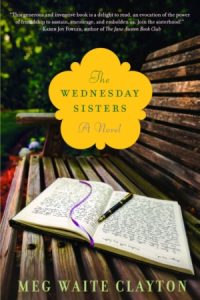
The questions that follow are intended to enhance your group’s reading and discussion of THE WEDNESDAY SISTERS by Meg Waite Clayton.
Questions
1. The Wednesday Sisters’ friendships are complex, constantly evolving, and occasionally downright messy. Yet even as their bonds are tested and threatened, the group endures and grows stronger. Does this circle of friends ring true to you? Are Frankie, Linda, Kath, Brett, and Ally’s relationships with one another similar to your own friendships?
2. Why do you think Frankie finds it so difficult to tell Danny that she’s writing a book when she has no trouble at all confiding this fact to her husband’s boss? What other secrets in the novel are kept and revealed in surprising ways?
3. Why does Kath go so far in trying to win Lee back? Did this surprise you? Would you, like Kath’s friends, be reluctant to counsel her to leave her husband?
4. What did you first make of Brett’s white gloves? What do you think they symbolize, if anything?
5. Linda’s breast cancer and Ally’s fertility issues cause them each to doubt their femininity, and leave their friends at a loss as to how to help them. Have you or a friend ever been through a similar crisis. What has helped you hold onto your sense of self through tough times? How have your friendships affected this experience?
6. The old abandoned mansion—“a Miss Havisham house,” as Frankie’s husband, Danny, calls it, after the moldering mansion in Dickens’ Great Expectations—is a haunting presence throughout most of the novel. What does this house seem to symbolize? Does it mean something different to each of the Sisters? What do you think is the significance of its destruction?
7. Published books are mentioned throughout the novel – from The Great Gatsby to The Bell Jar to To Kill a Mockingbird. What role do these titles play in THE WEDNESDAY SISTERS? Why do you think each of the Sisters chose the “model book” she did? What book might you choose yourself?
8. In THE WEDNESDAY SISTERS, a writing group helps its members grow in self-awareness and self-confidence. Have you been a part of a group – perhaps even a reading or writing group – that has had a similar effect?
9. In one memorable scene, the Wednesday Sisters gather in a funeral parlor and imagine what they can accomplish in their lives that will not perish with their deaths. Did this make you think about writing in a new light? What about motherhood?
10. The women’s movement provides an evolving backdrop to lives of the women in THE WEDNESDAY SISTERS. How did you relate the experiences of the Wednesday Sisters to events in your own life or in the lives of women you know who experienced it?
11. THE WEDNESDAY SISTERS make a ritual of watching the Miss America pageant every year. How do their reactions to the pageant change over time, and why? How does the pageant itself change?
12. If the Miss America pageant is one recurring motif in the novel, the space program is another. What similarities and differences do you see in the way the author uses these two iconic slices of Americana?
13. Brett’s novel, The Mrs. Americas, posits a future in which a spaceship crewed by women and carrying a cargo of frozen sperm takes off on a mission to propagate the human race beyond the confines of our solar system. Why do you think Clayton chose to have Brett write this particular novel?
14. In addition to exploring the empowerment of women and the prevalence of sexism, THE WEDNESDAY SISTERS addresses other social issues. In what ways are race and class raised in the novel?
15. Why do you think Clayton chose to set the book in the era and the place that she does? How might the story be different if it were set in the present day? In a major city or a small town, rather than middleclass suburban Palo Alto?
16. Why do you think the author chose to set the climax of her novel on the set of The Tonight Show with Johnny Carson? How does this scene compare to the Miss America pageants described throughout the novel?
17. In the accompanying interview, author Meg Waite Clayton says, “If an author makes me weep, I am theirs—though why so many of us like books that make us cry puzzles me to no end.” Do you share this sentiment? Why do you think readers respond to novels that make us cry?