The Story Behind the Book
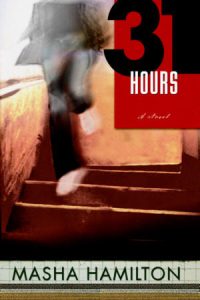
31 HOURS by Masha Hamilton
 One Sunday afternoon in March when I was fourteen, my friend Cindy was murdered in the Arizona desert not far from my home while on her way to my best friend’s house. We were in eighth-grade English and math class together and we played afterschool volleyball, and on Monday morning, when my parents came into the bathroom while I was getting ready for school, their faces white and a newspaper clutched in my mother’s hand, I didn’t understand what they were saying. “You mean she won’t be in school today?” I asked, unable to grasp that Cindy would never be in school again.
I was a lucky kid: this was my first encounter with violent death, life’s randomness and the merciless truth that much lay beyond my control. I slept poorly for weeks, convinced a killer lurked in the dark outside my window. Once I dreamt of Cindy. She told me she was okay. When I asked if she’d been scared, she admitted she’d been so afraid she’d peed in her pants. The dream was very real. Every March I thought of Cindy, and every volleyball season, and every graduation and those first dances and dates and kisses, too. All the moments she would not have. She remained, in fact, on the minds and in the conversations of my group of friends, part of the fabric of our passing childhoods, impacting the way we came to embrace or defy the world.
Ten years later, now an Associated Press reporter, I was assigned to cover the Steven Judy story. As Cindy had been my age at the time of her murder, Judy was my age then, twenty-four. He’d been sentenced to death for raping and killing a single mom and drowning her three young children in an Indiana creek. The case generated wide interest because Judy was one of the first inmates scheduled for execution after a nationwide death penalty moratorium. When I met his foster mother, Mary Carr, she showed me a photograph of Judy. “Isn’t he handsome?” she asked. My stomach twisted. I looked away and stumbled through a reply. Handsome? It seemed an obscene word to use in this instance. Steven Judy was a murderer like the man who killed Cindy. Both were hideous.
But I’d been assigned to get as close as I could to the foster family in the months leading up to Judy’s execution, so I repressed my initial revulsion. I spent time at the Carr home, went swimming with them, shared pizza in a restaurant, and examined even more photos while listening to stories of Judy’s life. I learned that his birth mother had sexually abused him as a boy, leaving him with a wellspring of confusion and anger, and that he’d acted out violently in the past in what were clearly cries for help. I learned that he’d asked the court to sentence him to death and begged his attorney not to appeal because he feared if he ever got out, he’d kill again. And I learned that Carr was haunted by what-ifs and tender memories of her boy, her foster son, moments when he’d acted with unreasonable generosity or gentleness. “Even though the public has never seen Steven Judy cry, I guarantee he cries frequently,” she said.
None of this, of course, made what he’d done forgivable to me, not in the slightest. But it made it more complex.
In March 1981, eleven years nearly to the day after Cindy had been murdered, Steven Judy died by electrocution at the Indiana State Prison in Michigan City, while I sat with Carr and her family in a room at a nearby Howard Johnson. When his attorney came to tell us about the last ninety minutes of Judy’s life, Carr wept, and I cried, too. I cried for Cindy and for Mary Carr and, yes, for Steven Judy. I was surprised by this, even disturbed. Does being able to see both sides of a story make you empathetic—or perverse? Does it make you human—or inhumane?
Today I’m a mother of three and a writer of novels, and what happened to Cindy and Steven Judy and Mary Carr troubles me as much as it ever did, maybe more, sometimes morphing into profound worry for my own kids. It’s a wound that never quite closed.
It’s a wound that gaped open again as I worked on 31 Hours, which is the story, told in multiple viewpoints, of a 21-year-old man named Jonas who is contemplating an act of violence—thirty-one hours from when the story opens—in the New York subway system. Jonas is young and idealistic and confused, and believes he will be killing ideas, but doesn’t quite understand there will be human victims too.
At its emotional core, it is the story of Jonas and his mother, Carol. It’s about maternal intuition, its potency and its limitations. And maternal memory: do we all see a six-year-old, the sweet years, lurking somewhere behind our 21-year-old’s façade? It’s also about navigating the confusing terrain of young adulthood, crowded with landmines and seemingly insurmountable gaps between who we are, who we believe we should be, and who, given the chance, we will become.
It’s a story, too, that asks for compassion where compassion is difficult. And this worried me in the same way I felt worried when I wept for Steven Judy. Would the reader find it impossible to empathize with Jonas, a young man struggling toward maturation, idealistic but unrealistic, contemplating an act of violence he doesn’t truly comprehend? Was I wrong to even ask for that?
As I was finishing 31 Hours, a strange piece of synchronicity occurred. I was approached by my agent to consider writing a nonfiction book about Sally Goodrich, a mother who lost her oldest son on 9/11 to the very same type of violence my character in 31 Hours is contemplating. Sally became snared for years in intense grief. Once, moved by a desire to understand, she tried to find a way to meet the mothers of the hijackers of her son’s plane. She too felt there might be something to discover in this relationship between mother and son. This last September, I spent a heartbreaking 9/11 anniversary with her. Ironically, it reminded me of being with Mary Carr. And then, as I made my final edits on my novel, all these life stories began to swirl in a single pot: a murdered child, a child murderer, a bereft mother, an unspeakable act. And no answers—or none that came easily.
31 Hours is not about Cindy, or Mary Carr, or Steven Judy, or Sally Goodrich, although all of those people were in my sideview mirror as I wrote. In the end, what I hope for in 31 Hours may be best expressed by Francois Bizot, a French scholar captured in Cambodia by the Khmer Rouge in 1971, who wrote the memoir The Gate about his months of suffering and interrogation in a prison camp. Through it all, he remained bitter and infinitely sad, but deeply compassionate toward tortured and torturer alike.
“I think we should maybe have the courage,” he said at a New York City literary event a few years ago, “to identify ourselves with and humanize the torturer. Maybe we should look at ourselves, instead of saying ‘never again,’ which does not work. We could maybe try to ask a new question, as well as a very old one: ‘How is it possible?’ We may find the answers in ourselves.”
Bizot’s question—how is it possible—is one that 31 Hours engages. It’s a question that scares me. This time around, it’s my novel’s forbidden topic.