Book Group Guide
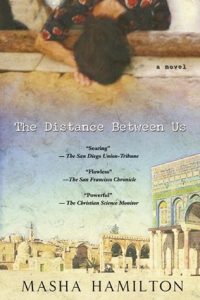
The questions that follow are intended to enhance your group’s reading and discussion of THE DISTANCE BETWEEN US by Masha Hamilton.
Questions
1. The essence of this book is in its title. Distance exists in the political landscape of this novel as well as in Caddie’s life. What are some of the historical and cultural differences that create distance between the Palestinians and the Jews in this story? How does creating distance influence Caddie’s relationship with Marcus? her professional colleagues? her friends? her community? herself?
2. In an instant, Caddie loses the two elements of her life most dear to her: Marcus and her professional detachment. How has reporting about violence in the past affected her?
3. After Marcus’s death, Caddie finds herself drawn closer and closer to dangerous situations, putting herself at increasingly greater personal and professional risk, as if she were invincible. What drives this reckless behavior? What other professions encourage similar forms of escape? Does escaping become addictive?
4. What is behind Caddie’s strong attraction to Goronsky? From the beginning, he is not honest with her yet she continues to rely on him.
5. Lingering thoughts of revenge plague Caddie. Did you expect this? How do her experiences with Goronsky, Avraham, Halima, and others affect her attitude?
6. The female characters in this novel—including Ya’el, Sarah, Halima, Anya—are diverse women who represent many cultures and values. How does each affect Caddie’s actions and influence her decisions?
7. Memories of Marcus’s death haunt Caddie. Is she in any way responsible for his death, or is she struggling with her own guilt for surviving the ambush? How does Marcus’s journal—and perhaps his death—help her to heal?
8. Sarah tells Caddie, “Two kinds of people find their way to this place. Those who leave, and those who stay.” Does Caddie’s decision to stay surprise you? Will her personal and professional losses reshape her reporting style?
9. This fictional account of violence in the Middle East parallels many real-life, contemporary scenarios, both at home and abroad (for example, the war in Iraq, September 11, Columbine High School, Kosovo, Sarajevo, and Sudan). What motivates the kind of coverage given to these events? Is the reporting informative or voyeuristic, merely feeding the general public’s appetite for violence?
10. This book is dedicated to Kevin Carter, a photojournalist who won a Pulitzer Prize for his disturbing photo of the famine in Sudan. In the picture, a gaunt Sudanese child crouches low to the ground while a vulture lurks nearby. Not long after winning the Pulitzer, Carter took his life. As a strict observer, journalists sometimes may have to let violence and brutality occur because if they become involved, they may change the outcome of the event or the public’s understanding of a situation. Are there situations when a journalist should become a participant or is it better to remain an observer?
About the Author
Masha Hamilton worked as a foreign correspondent for The Associated Press for five years in the Middle East, where she covered the intefadeh, the peace process and the partial Israeli withdrawal from Lebanon. (See more by clicking on the Masha Hamilton Bio button)