Macalaster Lecture
October 26, 2005 — 7:00pm
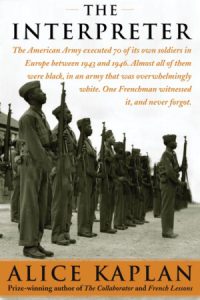
Alice Kaplan Lecture and Reading from THE INTERPRETER
Introduction by Professor Nick Dobelbower
 Good evening. I am Professor Nick Dobelbower from the Department of French and Francophone Studies. On behalf of the students and faculty of Macalester College, I would like to welcome everyone present and thank you for joining us this evening. I would also like to thank Tom Bielenberg of Micawber’s Books in Saint Paul for arranging this event at Macalester College. It is now my pleasure and honor to introduce our distinguished guest, Professor Alice Kaplan.
I have known Professor Kaplan for many years. She was, in fact, my professor and one of my mentors. She impressed upon me personally, as her student and as a reader of her successive books, the importance of archival research as a means to give life to untold stories and to bring to light past injustices that can only be remedied if they are confronted and studied. Despite the gravity of the problems she addresses, Professor Kaplan refrains from pronouncing judgment, as she does from excusing unethical behavior, maintaining instead a respect for the historical record and a probing curiosity that leads us to a new appreciation of the complexity of the problem at hand.
Professor Kaplan has had a distinguished career. She holds joint appointments as a Professor of Romance Studies, Literature, and History at Duke University, where she also founded the Center for French and Francophone Studies. Her appointment in three departments speaks to the rich interdisciplinary character of her work, which is readily apparent in her new book, The Interpreter.
Professor Kaplan’s work is representative of the best work being done in the field of French and Francophone Studies. Her unique ability to approach crucial intellectual and social questions in a multi-dimensional way also illustrates one of the primary aims of the liberal arts education that we value here at Macalester.
From the publication of her first book, The Reproduction of Banality, Fascism, Literature, and French Intellectual Life (1986), Professor Kaplan has been part of a group of dedicated researchers shedding light on a period of French history that French intellectuals were themselves slow to confront. In a similar manner, The Interpreter exposes a tragic dimension of US history that Americans have been reluctant discuss.
French Lessons: A Memoir is well known to students of French across the country. It was nominated for the National Book Critics Circle Award and was on the list of “notable books” for the year 1993 by the New York Times Book Review,. In French Lessons, we learn of the personal circumstances that drew a young Alice to find refuge in the French language. A native of Minnesota, she lost her father at a young age and learned of his career as a prosecutor at the Nuremberg war crimes trials only through the letters and documents that he left behind.
In the year 2000, Professor Kaplan published The Collaborator: The Trial & Execution of Robert Brasillach. Like her previous memoir, this new book garnered immediate critical acclaim. It won the Los Angeles Times Book Prize in History and was a Nominee for the National Book Critics Circle Award and a Finalist for the National Book Award for Nonfiction. The Collaborator causes us to reflect on the circumstances that lead France to execute one of its leading intellectuals, not for any direct participation France’s deportation of some 75,000 Jews, but solely for the vitriol of his fascist writings.
Finally, Professor Kaplan is also an accomplished literary translator and theorist of translation, which leads us to the work that you have come to hear about this evening. In 2003, she translated a novel by Louis Guilloux entitled OK Joe. In the novel, Guilloux fictionalizes his own experiences as a translator for the US military during the liberation of France at the end of World War II.
It was Guilloux’s astonishment at the racial segregation of US troops in France and his discomfort serving as an interpreter at the capital trials of two soldiers, one white, one African-American, that directed Professor Kaplan to examine the tragic effects of Jim Crow in the US military. Louis Guilloux is at the nexus of the events that Professor Kaplan relates in The Interpreter. In many ways, we find in the person of Guilloux, a figure for Professor Kaplan herself. Where he was a devoted lover of English, she is of French. Both have served the Anglophone and Francophone communities as linguistic and cultural interpreters, and both have shown their willingness to shoulder the mantle of responsibility to address injustice where they are witness to it.