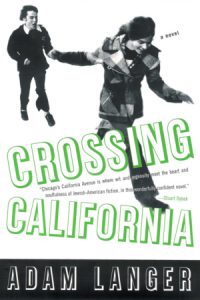
CROSSING CALIFORNIA by Adam Langer
In
the early 1970s, when I started going to grade school on the northwest
side of Chicago, there was a phrase I used to say to myself as I was
walking home: “Once you cross California, everything’s ok.” The
phrase referred to California Avenue, a street that traversed the north
side of Chicago and formed a significant boundary in the predominantly
Jewish neighborhood where I grew up and where my parents still live.
California was one of two streets in West Rogers Park that for all
practical purposes separated classes. West of California was largely upper
middle class, east of California mostly middle class. The second boundary,
Western Avenue-Chicago’s longest street-demarcated the separation
between middle and working class. Before I was born, my family lived east
of Western; when I was going to school, we lived just one block west of
California.
For my family, crossing to the west side of California represented their
arrival and assimilation into mainstream, middle-class American life. My
father was born in 1925, the son of Eastern European immigrants who spoke
exclusively Yiddish; one of his earliest jobs was as a Prohibition-era
bartender in a speakeasy in the Levee District, which was ruled by Al
Capone. Later, my grandfather worked as a trucker for a soda pop
distributor. My mother was born in 1927 on the west side of Chicago. A
good portion of her youth was spent living in the back of a store run by
her father. I grew up listening to my mother tell stories about her father’s
attempts to perfect various inventions he had designed. By the time the
1960s had rolled around, my parents’ connections to their family’s
immigrant past had just about disappeared; they vacationed in Colorado,
New York City and Washington DC; they owned a Ford Thunderbird and a
Volvo; in their three-bedroom West Rogers Park house, there were two
televisions, two hi-fi’s and a pool table. In 1967, the year I was born,
only one of my grandparents was still alive. Last Memorial Day Weekend, my
uncle passed away; he was the last member of my family to have the last
name Herstein, which I decided to take as a middle name while writing this
novel.
Alas, perhaps thankfully, Crossing California is not a family history, nor
is it a personal memoir. But, like my parents’ journey from Chicago’s
old Jewish West Side to West Rogers Park, it does deal with a period of
transition in my life as well as in Chicago and America at large. The
novel is set during the 444 days of the U.S. hostage crisis in Iran.
Memory tends to simplify matters, but with the exception of the present
moment in America, I can’t recall a time in our country during which the
mood and political climate shifted so quickly. On November 4, 1979 when I
was in eighth grade, Jimmy Carter was president, Jane Byrne was Chicago’s
first woman mayor, there was a permissiveness and openness to the city,
kids would hitchhike to school, drugs were prevalent yet never seemed
overly threatening, the feminist and black power movements had not yet
fallen out of favor with the national government. And, I might add, before
November 1979, hardly anyone had heard of radical Islam. On January 20,
1981, Ronald Reagan was being sworn in as president; the U.S. hostages had
been released, but I recall a sense of cynicism and fear beginning to take
hold. Chicago’s government was once again mired in corruption; Muhammad
Ali’s career was through; John Lennon was dead; xenophobia and moral
absolutism were growing. The phrase “Just Say No” was soon to become
the nation’s motto. And the chant “USA! USA!” began to seem less a
patriotic cry than a threat. In just fourteen-and-a-half months, my life,
my city and my country all felt markedly different, something that seemed
to have little to do with the fact of my Bar Mitzvah.
At this point, I hasten to add that none of this novel about the
intersecting lives of three families in West Rogers Park is
autobiographical. Still, I do share experiences with almost each
individual character. Like the young filmmaker and radio personality Muley
Wills, at the age of 13, I worked as an actor, reporter and editor for a
local NPR affiliate, as well as an amateur and, later, professional
filmmaker. Like his mother Deirdre, I worked briefly as an instructor in
the Chicago public schools. Like his father, Carl “Slappit” Silverman,
I spent time working on play scripts in Chicago’s African-American
entertainment world. Like Jill Wasserstrom, the object of Muley’s
desires, I was Bar Mitzvahed in 1980 and also proudly defended the
policies of the Ayatollah Khomeini in front of a class of appalled eighth
graders. Like her father Charlie, I worked during high school as a
reporter for a chain of low-rent neighborhood newspapers. Like her sister
Michelle, I was a high school thespian (though I was nowhere near as
talented as she is, despite having shared the stage with such luminaries
as Chicagoan John Cusack). As for the Rovner family, I too lived west of
California, and though I would prefer not to think I have much in common
with any of them, of course I do. Like 13-year-old Lana, I briefly hosted
my own prepubescent radio show entitled “Adam’s Perspective.” Both
of our fathers happen to be radiologists, though if my father was ever as
sex-obsessed as hers, I’d prefer not to know. Like Lana’s brother,
Larry, I was a crappy guitarist with dreams of rock ‘n’ roll stardom.
Like her mother Ellen, my father once saved my life in an almost-comical
way. And, like one of the minor characters in the novel, I too suffered an
existential crisis at the age of 13 when I accidentally extinguished my
synagogue’s eternal light. But what feels most autobiographical to me in
this novel are not these individual stories and personality traits, but
the sense of transition in my life and the lives of those around me during
the 444 days between Autumn 1979 and Winter 1981.
Though my parents still live in their house west of California, of course
the neighborhood of West Rogers Park has changed. Most of the first
generation Jewish families who are still living have departed-to
retirement homes, to the suburbs, to Phoenix, to Hot Springs, to Miami
Beach. In their place are the newer immigrants-the post-glasnost Russian
Jews, the Asians, the Indians, the Palestinians. And yet, the borders
remain. But, even though I have crossed different borders since I moved
out of the neighborhood-from West Rogers Park to Lincoln Park; from
Chicago to New York City-whenever I visit my old neighborhood, I still
feel slightly nervous every time I cross over to the other side of
California.
About the author
Adam Langer is an editor, journalist, author, playwright and filmmaker.
With the publication of CROSSING CALIFORNIA he is now a novelist as well.
Over the years, he has worked as a radio news writer and producer, an
actor and a stand-up comedian. He has lectured on writing and journalism
and has been a commentator on books on national television. He now divides
his time between New York City and Bloomington, Indiana.
Return to main book page...