Publishers Weekly Interview
Publishers Weekly Interview — 4/26/2004
Crossing Genres — by Roger Gathman

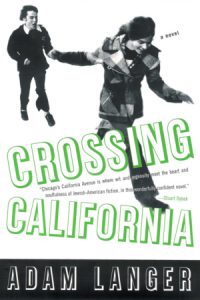
 PW: Crossing California concerns the interlocking lives of three families in Chicago’s West Rogers neighborhood during the Iranian hostage crisis. Why did you choose this time period?
Adam Langer: To use the journalistic cliché, a lot of the ’60s ended in 1980. There was the loss of so many icons: John Lennon died, Muhammad Ali retired and Led Zeppelin broke up. Then there was the election of Ronald Reagan. And there was the rise of the fear of the Middle East. I can’t say the latter hadn’t been present before-I was 10 at the time-but it seems to me it was a new thing.
PW: Did you do much research?
AL: I read the newspapers after I’d finished the manuscript. I wanted to avoid having references that were too obvious: people watching Dallas and playing with Rubik’s Cube. There was a much larger first draft, and I cleverly left out a lot of overkill in the final version. To give myself a treat, as I was writing, I’d go out and buy stacks of that period’s records: Boston, Chicago-I made my poor wife heartsick of listening to Boston and Heart.
PW: A high school drama club and a radio show for kids play a big part in the novel. Is this autobiographical?
AL: I grew up in the West Rogers Park region, but went to high school in Evanston. I wrote plays back then, [and] I went to Vassar and wrote plays. After college, I worked as a drama critic for the Chicago Reader and I had some of my plays performed. One of my plays, The Blank Page, went to New York. I even got floated money to make a movie of it, which I did.
As for radio, I spent a lot of time when I was a kid hanging around the local NPR outlet, learning how to cut up tape and stuff. When I was in eighth grade, I was part of a show called Audio Jam, which was supposedly written by kids, although it really wasn’t. I finally got kicked out of the station because I interviewed someone in the army and the station got a complaint that I didn’t have permission.
PW: This is your first novel. How did you transition from drama to fiction?
AL: I started writing some short stories. My idea was that each short story would be written by some invented author. One of them was set in a neighborhood in Chicago full of bodegas and tough guys. I decided to rewrite it and put it in my old neighborhood, which I’d never written about. So I replaced the bodegas with kosher Chinese restaurants. I wrote a page where three characters meet on California Ave., and I decided I wanted to know more about these characters. And that grew to 900 pages.
PW: The characters are mainly Jewish, but one of your three families is black. There is ethnic tension in the book, but one doesn’t get a sense that there is any grand Other. Was this intentional?
AL: The historical relationship between blacks and Jews interests me, but this novel isn’t about capital “B” blacks and capital “J” Jews. I think when Philip Roth, for instance, was writing The Human Strain, on every page you could see something was standing for something else. I did grow up in a multi-ethnic neighborhood. There wasn’t the racial feeling there that, perhaps, writers who came of age in the ’50s had to deal with, although still, in my childhood, there was a dinner table sense that everybody was racist but Jews, and then Grandma would start up about the Schwartzes.
PW: This novel is getting a lot of early buzz. Are you excited?
AL: To me, it doesn’t seem real yet. I spent time as an editor at Book magazine interviewing debut novelists. I’ve seen a lot of hype. I’ve had plays go up, and people telling me I’ve made it, and then I had to work to get the next one up. I had a lot of fun writing it, and I just hope that shows to the reader.