Chicago Tribune Feature
Chicago Tribune – August 28, 2005
By Jessica Reaves
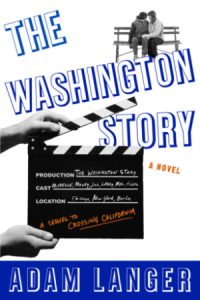
 What’s a fitting follow-up to a hit novel? A sequel, of course.
In author Adam Langer’s mind, however, “The Washington Story” is a different kind of sequel. His 2004 debut, “Crossing California,” was a popular and critical success, raking in reviews that many veteran novelists would kill for.
The thing is, Langer says, he never really stopped writing “Crossing California.”
Sure, he crafted something like an ending for the purposes of getting the book out, but the story continued in his mind, so he kept writing it down. The result is “The Washington Story.”
“In a way, I don’t think of this as a sequel,” Langer said in a telephone interview from his home in New York City. “I was still really interested in the lives of the `Crossing California’ characters, and I wanted to keep telling their stories.”
Initially, he said, he conceived of the chapters in his new book as five separate sequels, each of which could stand on its own.
He said his writing technique remained the same throughout the process:
“I left a lot of unanswered questions at the end of both `Crossing California’ and `The Washington Story. And I like to write using a sort of question-and-answer format, so that kind of setup was really helpful to me.”
Also helpful: expanding the characters’ worldviews. While “Crossing California” is very much a novel of and about Chicago, “The Washington Story” takes the characters beyond their native city, and into New York and Berlin.
“When I was writing `California,’ I had an image of characters within a very narrow boundary system,” Langer said. “But with this book, I wanted to explore what happens when those boundaries are ruptured, what happens when characters advance not only outside their neighborhood into the rest of Chicago but outside Chicago and into the rest of the world.”
Of course, Chicago still plays a large role in “The Washington Story,” as evidenced by the title, which is not a reference to the nation’s muggy capital but to Chicago’s former mayor. The tenure of Harold Washington provides a backdrop for Langer’s characters, and researching it gave the author a new perspective on the way history is preserved.
“I hunted around for audio of Harold Washington’s speeches,” Langer said, “and I was totally shocked by how few were available. He was a wonderful speaker, and there’s really a dearth of information, historical context, records, especially when you consider how seminal a figure he was in 20th Century politics.”
Langer, a Chicago native and child of the 1970s and ’80s, was able to recall much of the novel’s history, but he went back and double-checked specifics.
“This era is very fresh in my mind,” he said. But there were some things that surprised him in retrospect. “Looking back at the 1983 campaign and election,” he said, “I was really astonished to see that [Richard M.] Daley, not Washington, got the endorsements of most city newspapers. That’s not at all how I remembered things.”
Now that the second (although probably not last, he hints) chapter of the West Rogers Park characters is closed, what’s next for Langer?
He and his wife just welcomed a new baby, and he’s working on something that is “completely different from these last two books.”
“It’s not set in Chicago, and it’s not a period piece.”