Random House Interview
During the summer of 2005 Judy Larsen was invited to New York to the Random House/Ballantine offices, and while visiting there, she was introduced to Bev Marshall, author of Walking Through Shadows, Right As Rain, and Hot Fudge Sundae Blues. After Bev said how much she loved All The Numbers, she asked Judy if she’d answer a few questions about her novel over a cup of coffee. Judy agreed, and soon the two authors were settled in a nearby café sipping coffee, chatting like old friends. Here are a few bits and pieces of their conversation that afternoon.
Bev: I’ve already told you how much I loved All the Numbers, but I didn’t tell you that I actually stayed up until 3.a.m. reading it. I just couldn’t go to sleep until I knew what was going to happen to poor Ellen.
Judy: Well, I’d say I’m sorry you lost sleep, but I’m not. What a thrill to know you couldn’t put it down.
Bev: I’d bet I wasn’t the only reader you kept up late, and I’d also wager that I wasn’t the only one who wants to know if this was an account of a personal experience. Have you suffered the loss of a child?
Judy: Thank God, no. But I think most parents have had those scary trips to the emergency room when you hope your child just needs a few stitches or those moments of terror when your toddler is lost in a crowd, and you try to remember what he was wearing. As a mother, one of the most frightening moments I had was when my first grader was hit by a car. I was frozen for a few seconds. I didn’t want to run out and check on him because I was so scared of what I might have to face. He turned out to be fine, but of course I didn’t know that yet.
Bev: Thank God for that! So was your son’s accident the inspiration for All The Numbers?
Judy: Not exactly. I think I’d been dreaming it up for years— ever since I became a mother and learned that overwhelming, awful truth of how much I loved my sons, how much I wanted to protect them, and how in so many ways I was powerless.
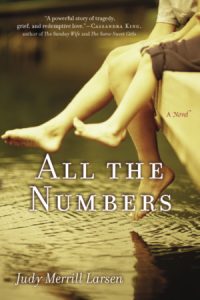
Bev: I’m a mother, too, so I know exactly what you mean. What was so very chilling to read was the contrast between this idyllic scene at the lake and the horror that followed. I could visualize that scene, hear the jet ski approaching. I’m guessing you’ve spent some time on a lake yourself. Am I right?
Judy: Yes. Just like Ellen, I’m lucky enough to have a best friend who has a lake house and we go there often. The story came to me one summer day on her dock in Lake Ripley in Wisconsin. We sat there, sipping wine and talking as her daughters and my sons played in the lake. A jet skier went by. And I started to think, what if? What if one of the children had been a bit farther out? What would that do to me as a mother? To our friendship? To the other children? The story flowed from there.
Bev: Speaking of flowing. I think you should give out boxes of tissues with your book to wipe all the tears that your readers will shed. I used up an entire box myself.
Judy: You know I hear that from everyone who reads this. Even men. And I find it very gratifying that I am able to elicit that kind of emotional connection with my words. I still catch myself tearing up when I reread certain parts of the book, and it’s good to know I’m not the only one sniffling.
Bev: Like most authors, I have great empathy for my characters, and I’m sure that you do, too. We live inside their bodies as we write, so how on earth did you manage to survive writing about Ellen’s pain?
Judy: Well, it was hard because I did relate to Ellen so closely. There were days I was just exhausted for and with her. And my poor sons—they were the same ages as Daniel and James the summer I wrote the first draft, and they’d be headed to the pool and I’d be hollering after them, don’t go in too deep, and be careful and what I really wanted was for them to sit inside where I knew they’d be safe and sound.
Bev: I know what you mean. I feel the same way about my grandson every time he goes to our pool.
Judy: So there never comes a point when we get to relax? I hadn’t even thought about worrying about future grandbabies, Bev.
Bev: Nope, you never stop worrying. Motherhood is a lifetime profession. But besides understanding the fears of us mothers (and grandmothers), you seemed to know so much about the stages of grief and all of the complex emotions a mother would feel after the death of her child. How did you know this, Judy? Did you consult professionals or do other kinds of research about the subject?
Judy: Again, I think the only research I did was forcing myself to imagine the very worst. I think that’s how I cope with fears—try to go all the way through to what would I do. Who would I call? I wanted Ellen to have honest reactions. That’s what always intrigues me when I hear or read about real-life accidents and tragedies. I always want to ask the survivors—what’s your new normal? How long did it take you to get there? I remember reading an article about Elizabeth Edwards and she said how after her 16-year-old son was killed she just watched the weather channel day after day after day. And I thought, yeah, that sounds about right, I could see myself becoming almost catatonic.
Bev: I think that’s so brave of you, to vividly imagine the worst happening. That’s probably why I thought this novel was a personal experience. You also captured exactly how I think a teenage boy would react to all of the events that occur in the novel. I know that, like me, you are a teacher, and I’m wondering if your perceptions of Daniel were based on your interaction with your students?
Judy: I think it was based on both my students and my sons. I really find those early teenage years, especially with boys, to be such a fascinating time. They aren’t little boys anymore, but they don’t have the confidence and swagger they’ll have in a few years. There is such sweetness there, but also a coolness or distance. I always describe my ninth grade students (mainly the boys) as like puppies. They mean well, but their feet are too big. And for Ellen, Daniel is becoming someone Ellen doesn’t know—partly because she’s so wrapped up in her pain, but also because that’s part of the growing up process.
Bev: I love that analogy of the boys’ feet and puppy paws. And while we’re on the topic of students and school, I noticed numerous references to numbers and the Capitol throughout the novel, which seemed to me to have symbolic significance. Did you consciously work these references into the text, and if so, how did you perceive their significance?
Judy: Did my English students feed you this question, Bev? I love symbolism, but I know there are always a few of them who sit and shake their heads thinking, “she is so making this stuff up.” What’s funny is that with the references to numbers, that was very intentional, but the references to the Capitol were not conscious at all. I thought the idea of numbers might tie in to things making sense—you know x + y = z. And of course for Ellen, those familiar patterns have been completely destroyed—what she is looking for are new patterns, new rules. Now that I think about it, the Capitol references kind of tie in to the same idea—you know, structure, order, rules.
Bev: Well, now I have to ask you if you were consciously conveying a message about organ donation to your readers. I was really surprised by Ellen’s reaction to donating James’s organs.
Judy: Let me say right off I am a huge believer in organ donation. My card is signed. I want to encourage everyone to become an organ donor. But I also think, that at least for me, donating organs in the face of losing a child wouldn’t bring relief right away. It certainly wouldn’t prevent me from offering my child’s organs, but it wouldn’t lessen my agony. This just fit with how I thought Ellen would react. She’s not noble in her grief. She just hurts, and there’s not a thing in the world that’s going to lessen that hurt other than time.
Bev: And I suspect that even time can’t heal the grief but only lessen the pain one must feel after losing a child. As I read the novel, I saw that Ellen’s reaction to that pain was to focus her thoughts and actions on revenge. She directs her rage toward Ben Buchanan and the manufacturers of jet skis. But Ellen experiences a complete turnaround in her sympathy for the Buchanan family, and she agrees to allow Daniel to jet ski. Did you foresee this happening, and if so, did you view these “epiphanies” as part of the healing process?
Judy: What I liked was how Ellen, initially so stuck in her grief and rage, gradually is able to look outward. I think that’s how she heals, and probably how we all heal. When all we can see is our own pain, that’s a very narrow vision. As Ellen sees things more broadly—through Daniel, through Ben’s mom and others, she is able to forgive and move on. So yes, all that is part of her healing.
Bev: And Ellen’s healing is revealed beautifully in the last scene. Oftentimes I’m disappointed by the endings of novels, but the ending of All the Numbers was just perfect. Did you know the outcome of the trial and the denouement for Ellen when you began writing or was this ending a surprise to you?
Judy: I knew she would ultimately forgive Ben—but I didn’t know all the specifics of how that would come about. That’s one of the things I love about writing—my characters let me know who they are as I write. It’s fun to have those moments where as I’m writing I am also thinking, “Hmmm, I sure didn’t see that coming.”
Bev: Oh, I know, I know. Oftentimes my characters surprise and delight me. I think they’re all a lot smarter than I am. So you didn’t know what the final scene would be?
Judy: I did know what the final scene would be—Ellen and the others, standing on the dock, spreading James’ ashes to the wind. The challenge was getting her to that point. I knew there would be a trial; I knew that Ellen would lose her “blood thirst” for Ben Buchanan. What I didn’t know was how she would get drawn into the mud—how she would be made to look guilty. That came in one of the later revisions.
Bev: Speaking of revisions, are you hard at work on another novel?
Judy: Yes—and it is completely different from this book. I promise you won’t need any Kleenex.
Bev: I don’t mind buying another box, but what is the new novel about?
Judy: It’s a romantic comedy about a woman in her thirties who has had it with dating—and with shaving her legs. So she decides if she quits one she can quit the other too. Then of course she meets a great guy—but she’s taken a stand and doesn’t want to back down. It’s called Razorburn.
Bev: I love that title, and I’ll bet nearly every one of your female readers can relate to razor burns. I know we both have to go soon, but I have just one final question: My readers are always curious about my writing habits, and I’m sure that your readers want me to ask you about yours. What’s a typical writing day like for you? How often and where do you write? Do you have a special talisman or ritual that helps you write?
Judy: I don’t know how typical it is, but a good writing day for me starts with me taking a long walk with my dog—often I’m the first one up, and this not only gets us some exercise, but it’s some time I can think about where my characters and I might be going that day. It’s a way for me to focus and get inside my characters’ heads. Once everyone in the house is off to work or school, I try to write for a few hours. This is my most productive time. I write my first draft (and make most of my revisions) in longhand—preferably sitting on my front porch with a cup of coffee, so my talismans would be a stack of new legal pads and some good ink pens (not ball point). I really like writing in longhand—it seems more intimate.
Bev: I knew you had a dog! Judy thanks so much for sharing all of this with me. I know you have to go back home, but I’ve had so much fun I hate to leave. Let’s plan to meet again somewhere soon. I have a feeling we’re going to become good friends.
Judy: Absolutely, just tell me where and when. And even more, I think our characters (and maybe even our dogs!) would be buddies too.