The Story Behind the Book
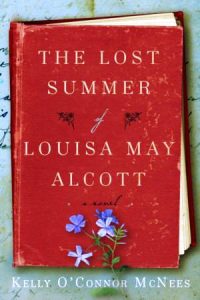
The Lost Summer of Louisa May Alcott by Kelly O’Connor McNees
 Like many American readers, I have always loved Little Women. But I never knew much about its author until I stumbled on Martha Saxton’s Louisa May Alcott: A Modern Biography one day while poking around in the library. I checked it out, and for some reason as I was reading I felt compelled to mark the sections I loved with sticky notes. I just didn’t want to forget any of the details. When I finished, the book looked like it was sprouting leaves—there were sticky notes on almost every page.
I read it again. I kept renewing it until they wouldn’t let me renew it any more. After that I went into the library through the back door so no one would corner me and try to get the book back. Finally one day my husband rolled his eyes and said, “Why don’t you just buy it?”
So I did buy it, along with all the other biographies of Louisa I could find. And right away I noticed something strange: Each biography portrayed Louisa differently. One painted her as a pioneering feminist; another described a reluctant spinster; yet another imagined her as little more than an extension of her famous father. After spending so much time reading about her, I felt I had to know—who was the real Louisa?
All the biographers had drawn their details from the same primary sources—Louisa’s letters and journals, among other things. So I decided to read them myself, and they simply took me over. My husband and I had recently relocated from Providence, Rhode Island—a fairly large city with a rich history—to the somewhat out of the way town of Waterloo, Ontario for his work. Leaving my job as a teacher in Rhode Island and trying to figure out what to do with myself in our new home left me feeling unsettled. I toyed with the idea of chucking my job search and making an honest effort to write a novel, something I had wanted to do for as long as I could remember. But I was afraid. What if I wasn’t any good? What if I had nothing to say? As I read Louisa’s description of her own anxieties about the writing process, I felt a faint twinge of hope. I knew I had to try to write, and I knew I wanted to write about her.
The final piece of the puzzle fell into place when I happened upon an excerpt from a memoir by Julian Hawthorne, the son of Nathaniel Hawthorne. Julian had been a neighbor to the Alcotts and a childhood friend of Louisa’s youngest sister May, the inspiration for Little Women’s Amy. Writing about Louisa, he said, “Did she ever have a love affair? We never knew. Yet how could a nature so imaginative, romantic and passionate escape it?”
And I thought, that’s it. I knew biographers believed that her fame drove her to burn many of her letters in an attempt to protect her privacy. It wasn’t too much of a stretch to imagine that perhaps she did have a love affair but erased all traces of it. But when would it have happened? I remembered a short section from one of the biographies that mentioned the Alcotts summering in Walpole, New Hampshire in 1855. Only a few solid facts are known about that summer—her father Bronson kept a garden, the sisters put on a play, and in the fall, Louisa went off to Boston to write and Anna went to Syracuse to work in an asylum. The lack of historical information made it the perfect setting for the story: a lost summer in Louisa’s life.
To this skeleton I added as many details as I could cull from books on nineteenth century New England dress, cooking, housekeeping, leisure, transportation, politics, and literature. I continuously reread Louisa’s letters and journals as I worked because I wanted the Louisa in my story to sound as much like the real Louisa as possible. I made a list of all the books she loved—Dickens was her favorite and she deeply admired Jane Eyre—and I pored over them looking for clues about what might have been on her mind. I tried to pull together the anecdotes that best showcased who she was. The picnic by the river, making candles with Anna, Bronson insisting his daughters read their journals aloud, J.T. Fields telling Louisa she should stick with teaching because she’d never make it as a writer—all of those things really happened in various forms.
Last summer, I traveled to Walpole for the first time. Up to that point I had been working from an old map of the town and some snapshots of Washington Square. It was wonderful and strange to walk through the town that seemed so vibrant in my imagination. I pictured the characters walking to the river, rehearsing the play in the attic of a downtown inn, and shopping for fabric in the dry goods store. I felt closer to them than ever.
I was thrilled to realize that Leaves of Grass was published that same summer. Emerson read it immediately and probably talked about it with Bronson. Discovering the historical coincidence of Louisa’s lost summer and Whitman’s great work felt like a very good omen. Nothing in American literature could bind two restless hearts in love like that volume of poetry. This seemed to bring the story together, and at that point I committed to following it where it might lead.
Most of the few pictures of Louisa that survive were taken when she was older, after the success of Little Women catapulted her to almost instant fame. In them she appears tired and much older than she probably was. By then the calomel—otherwise known as mercury chloride—she had been given as a treatment for typhoid had wreaked havoc on her joints, skin, and hair. In her later years she was in almost constant pain, and this is evident in the images that appear in all her biographies—one of the only things they all have in common.
But there is one picture of her as a young woman in her early twenties. She isn’t smiling—most people didn’t smile in pictures then because they were self-conscious about the poor condition of their teeth—but the intensity of her gaze hints at how much life resided behind those eyes. This Louisa is young, vibrant, and full of anticipation for the joys and sorrows that lie ahead. I kept the picture on my desktop as I worked, and it sometimes seemed she was nudging me, bit by bit, toward the story she wanted me to tell.