Hyperion Interview
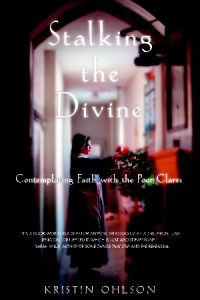
The Publisher talked with Kristin about the thoughts and events which led to writing STALKING THE DIVINE:
 Why did you decide to write about the Poor Clares of Perpetual Adoration?
I seem to make my way through life by following one impulse after another. Another way of saying this: I think about the things I want in my life and yearn for them for years, then suddenly lurch in that direction without much conscious thought or planning. It was that way with the Poor Clares, both encountering them and writing about them. When I was younger-in my twenties and even part of my thirties-I was exceptionally scornful of people who believed in God, but fascinated by them, too. Especially when it was someone I admired-usually someone I considered very smart-I just couldn’t understand how it was that they could believe in something that seemed as fey to me as belief in the Easter Bunny. It took a while for me to realize that I had a longing for faith myself-again, a longing that took years to work its way into any sort of action. That was how I happened upon the Poor Clares’ church. I read about an ad for a service on a Christmas morning when I was feeling blue-bereft of my children, who were spending the night at their father’s house. I read the ad, went upstairs and took a shower, and was down at their church in a half hour. And then I just kept talking about them to people and even wrote one short little piece about them-the part that became the first chapter of Stalking the Divine. I showed it to a friend, and she said, “Your heart’s in this! Keep writing about them.” Still, my old atheist self had a hard time with this-it felt thrilling but still shameful to be writing about belief in God and to admit its attraction for me.
Did you encounter any resistance from the nuns?
At first, I had a hard time getting their attention. They have a peculiar kind of tunnel vision-they’re completely focused on the great grievous things that are going on in the world and on their prayers, so a writer sending them letters about a book was quite outside their purview. It was like those hearing tests, when you have the headphones on and you’re supposed to push a button if you hear a sound and, for a long time, the sound is so low that you can hardly distinguish it as sound. This is the way it was, except that they weren’t listening for me: still, it took them a long time to recognize that there was someone who wanted their attention in this way. Then they kept asking me, “Who’d want to read about us? What’s interesting about us?” Someone else had told me that the Poor Clares were the kind of totally ethereal beings who could never countenance talking about themselves, but once I started meeting with them this wasn’t always the case. Some of them looked bemused with my questions-“why does she want to know that?”–but others were quite voluble. Their stories poured out of them.
Did you have a history with the church?
My father was a devout Catholic all his life, but my mother was deeply skeptical of Catholics. She associated them with her father and his family in Nebraska and probably Nebraska in general: to her, I think Catholicism was all harshness and false piety. So mine was the opposite of the typical family situation, I think: the father was the one taking the kids to church and the mother stayed home to do-what? I don’t know what she did when we were all out of the house. I have nothing but amiable feelings toward the Catholics of my youth-I remember the priests (except one) as cheerful, the nuns (after I got used to them) as bright and kind. But except for one brief period of time when I liked being in mass and wished I could be a nun (I think all little girls who went to Catholic school during that era wanted to be nuns at one time or another), I didn’t like going to church. I was a tomboy-does anyone use that word anymore?-and I was absorbed by all the pleasures of small town life at the foothills of the Sierra Nevadas: riding horses, catching snakes and tiny frogs, inciting battles among ants by leaving tasty morsels between anthills, playing Indians and settlers, looking for arrowheads and thunderstones, spying on the neighbors, swimming, throwing rocks, poking around in an old hermit’s cabin when he was out. I hated anything to do with wearing a dress, and, of course, going to church in the 1950s and 60s meant wearing a dress. After my brief period of saintliness, the only thing that was appealing about church were the signals the kids would send each other during mass, all under the adults’ radar-the gestures and noises and facial expressions that we used to tell each other how much we didn’t want to be there.
Were the Poor Clares your first reintroduction to the church?
No, I had encountered other nuns in the couple of years leading up to my relationship with the Poor Clares. One very young woman was an elementary school teacher, another sister was the head of a foundation, and another was on the bishop’s staff and worked on several issues, including his Church in the City campaign to pull together urban and suburban churches, fight urban sprawl, and revitalize the city; she also worked on a ministry to Cleveland’s gay and lesbian community. I met another nun while I was writing the book who was deeply involved with women in prison and who was leading a campaign to build housing for women coming out of prison so they’d have a safe, drug-free community, one that was wholesome enough for them to live again with their children. I was impressed with these women, with the range of honorable work they were doing. I was dazzled by their goodness. They were very different, not only from the nuns of my childhood but also from the Poor Clares.
How were you able to find any drama in the nuns’ story?
It seems that nothing ever changes inside the cloister-for the most part, they do the same thing day after day-but that’s not the case. A writer friend of mine was telling a writer friend of his about my book and asked if it was possible to tell their story-their apparent non-story-in a compelling way. The other writer replied in mock solemnity, “Someone must die!”-as if the only way to make this interesting was to turn it into a murder mystery. But despite the fairly changeless pattern of life behind the grates, there is tension, there is drama. The bedrock nuns are aging, and, as in other religious orders, their passing is not matched by a resurgence of young nuns. While I was writing the book, one of the older nuns died; another died shortly after I finished it. Also while I was writing the book, two young women were trying out the Poor Clares life. As I write this, another two young women are entering the cloister to see if they can live this extraordinary life, and two nuns from Korea have entered this monastery. Still, it seems possible to me that influx will never match demise, that this order of religious women might not last the century-maybe not even the next twenty years. And it seems to me that it would be a great loss for our culture if it doesn’t have a place for this kind of contemplative life-if the imagination of modern people is so small that it loses any kind of vision for sustained devotion, for the searching and scope and assurance of prayer, for this kind of selflessness. I have a feeling that most people would find the whole notion of poverty, as a lifestyle one embraces, weird and repugnant. And chastity-again, weird and repugnant. It’s interesting that when the Poor Clares began as an order in the 13th century, both of these -chastity and poverty- were a kind of women’s liberation.
Was it hard to write about yourself?
Very hard! In fact, in the early drafts of the book, one of the most common reactions was, “But what about you? Why were you drawn to them? There needs to be more about you in here!” So, I’d kind of grit my teeth and burrow into myself, trying to understand more about why I was drawn to the nuns-and to faith. It wasn’t a comfortable or easy process.
What else was going on in your life that influenced your interest in faith?
A few years before I started writing the book, I began leading a writers workshop for women who had previously been in prison. Again, it was something that I sort of stumbled into even though it was the kind of thing I wanted to do-when you write a lot of articles about people doing interesting or worthy things, you start to get an uncomfortable feeling about yourself as a mere observer, someone who documents while others do. I was writing an article about a wonderful program here in Cleveland that links women coming out of prison with a wide range of services that help them and their families get on with their lives. One of the things the women could sign up for was a writers workshop, which I thought was a great idea-and then a few months after the article came out, the person running the workshop had to quit and asked me to take over. I loved the workshop and the women in it (although that took a while-during our initial meetings, they were shy and nervous around me and I was shy and nervous around them). In terms of their writing, though, one of the things that troubled me at the beginning was that the women often wrote very religious poems, almost like psalms or hymns. I felt I needed to push them to do more than what I saw as repeating and rearranging religious cant. I wanted them to open up, to write about their feelings and their lives and their experiences in prison and now in society-I thought this would not only be better art, but would also help them in their tremendously difficult struggle to get away from the kind of destructive thinking and habits that had landed them in prison. It took a while, but I finally realized that they were writing these religious poems because it was their faith that was helping them pull away from that old life and hope for a new one. Their faith was a powerful force in their lives, and I learned to respect it.
You make a living as a freelance writer, but have you ever written fiction?
I’ve always written both nonfiction and fiction-I write articles about a wide number of things as well as short stories and novels. I love doing both and will probably continue to do both the rest of my life. Writing articles is a way of learning about everything in the world– I’ve written about fish that are bioengineered to glow when they encounter pollutants in the water, about feminist philanthropy, about how the structure of the brain influences learning, about South Dakota’s magnificently quirky Corn Palace, about whether or not cleaning off the Mona Lisa constitutes a sort of conservatorial vandalism, and so many other things. The freelance work requires me to become an instant expert on something, and I love racing up that learning curve and pulling my reader along with me. And I love writing fiction, too, creating a world and characters who become so alive that it almost feels as if I’ve just left their house. I don’t always love the act of writing, of course-it’s hard work, sometimes just drudgery, sometimes just plowing ahead when you don’t feel you’re getting anywhere at all. And sometimes you don’t, sometimes you throw most of what you’ve written away, but still it gets you moving and maybe leads you in the right direction. Then you just ride that blissful momentum for a while. I’m excited now because a new novel is starting to come together-just the notes, for now, scribbled on all sorts of things and dropped in a box. My main character is a woman who fascinates me for two reasons-she’s an expert at something (unlike me, intellectual dilettante) and she’s one of those people who stay behind in a small town when nearly everyone else who’s smart and ambitious has moved on. One of the things that intrigues me about this novel is that I’ll also get to do some of what I like best about writing articles: I’ll have to do the kind of research that will allow my character to be an expert.
Why didn’t you write about the pedophile priest scandal in Stalking the Divine?
The scandal hadn’t unfolded when I was interviewing the nuns and writing the book, and I really didn’t want to go back and insert it. It just didn’t make sense to me, especially since the book is structured in a loosely chronological way: it tracks my growing relationship with the nuns, changes in the cloister, and also my evolving thoughts about faith. I’m glad things worked out this way, too. If the scandal were in the papers during the period of time that I was meeting with the Poor Clares, I’d have to talk to them about that, too, and add my opinion to that of everyone else-and it seems that there are already enough people weighing in on this.