The Story Behind the Book
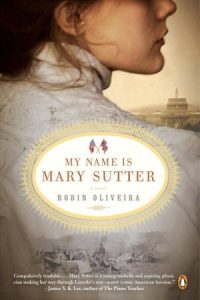
Five years ago I had a vision of a young woman in shabby period dress seated at a trestle table, bent over the shaft of a brass microscope fitted with a slide, a shallow candle burning under its glass stage. The candle illuminated both the object she was studying and the walls of bookshelves filled with thick volumes, specimen jars and human bones. She seemed so hungry for knowledge. Who was she, I wondered, and what was she doing by herself in that lonely place at night? What were her disappointments, and to what lengths would she go to become the woman she wanted to be? Was she loved? I became worried about her; I had to find out who she was.
It was when I learned that seventeen young women became physicians after their nursing experiences in the Civil War that this beguiling stranger began to declare herself. One thing was always certain: she would live in Albany, New York, whose cobbled streets and brownstones flicker in my childhood memories.
But other challenges loomed; preeminent among them was my ignorance about everyday life in the 19th century. I had so many questions. Did trains exist as a common mode of travel? When and where were women admitted into medical school? What was Albany like during the Civil War? I had to plunge backward in time, and I started by requesting microfilm of the Albany newspapers. I read issue after issue until my eyes ached. I learned that hogs still ran wild in the streets and that performers and spectators at Tweddle Hall, the entertainment showcase of the day, suffered gas inhalation from the leaky fixtures. I studied rare obstetrical books at the University of Washington Special Collections Library, read myriad histories of the Civil War, and Florence Nightingale’s textbook, Notes on Nursing. I discovered that the profession of nursing sprang up during the Crimean War, as it would ten years later in America as a consequence of the Civil War. I learned that midwives held sway over doctors and that when the war began, nary a single surgeon in America knew how to perform an amputation. Soon I was poring over surgeons’ manuals from France, midwives’ diaries and recipes for pharmaceuticals, and ultimately soldiers’ journals, not only of the Civil War, but of WWI and II also, where I learned that soldiers of any era crave a single, common outcome: to return to their families alive.
Mary and her milieu were unfolding, along with hints of her story, but slowly. She was a bright young woman with skills and appetites ahead of her time.
Soon I knew that the only place to find the rest of the information I needed was at the Library of Congress and the National Archives, where I spent a week unwrapping 150 year-old documents protected in shrink-wrapped plastic. Awed as I turned their brittle pages, I wondered whether I was the only person to have read them since they were first inscribed. I sifted through hospital admissions ledgers, zeroing in on the decaying Union Hotel Hospital as the place of Mary’s apprenticeship. The artifacts from the hospital included nurses’ scribbled grocery lists for five dozen eggs and six kegs of milk, blotched bed count tallies, rosters of temporary nurses hired after huge numbers of wounded overwhelmed the city, doctors’ official circulars and their employment contracts, and even one remarkable day in the Library of Congress, Dorothea Dix’s personal letters. But how to understand in a new way the iconic Lincoln, whose story insisted on being told alongside Mary’s? Only when I stumbled on the diary of Rebecca R. Pomroy, the nurse who sat at Willie Lincoln’s bedside as he died, did I have a view into his soul.
Infused with forgotten history, I emerged from Washington’s marble halls to stand transfixed at the Union Hotel’s former address in Georgetown, trying to erase the storm of modern life—the passing cars delivering their well-groomed patrons to the trendy boutiques and restaurants—to imagine the condemned hotel turned hospital, where men and women exhausted themselves in its ramshackle rooms endeavoring to preserve life against unremitting devastation. Now a gold-domed bank occupies the site and the canal below that once transported the wounded on packed boats instead shuttles tourists in canoes. But inside those long-gone walls, earnest men and women once learned about medicine, bemoaned how much they had yet to learn, and left clues behind as to their struggle. How could I not tell everyone?
And, finally, when I thought the book might end in Gettysburg instead of Antietam, I roamed the grassy Pennsylvania hills of the battlefield with a guide who painted the story of Pickett’s regiment surging toward the angle of the stone wall, which was the apex of the Confederate push northward. Then he led me to the unpretentious hillock where Abraham Lincoln gave his spare and perfect address, savagely disparaged at the time for its brevity. I looked out over the cemetery his brilliant speech had consecrated and thought that the Civil War had infinite stories to tell, one for every person affected by its pervasive reach. By the time I knew that Antietam, and not Gettysburg, would conclude the book, that famous Maryland cornfield was my cornfield, and it was I who was rushing to my death that foggy fall morning.
And through it all there was Mary Sutter, whose story I needed to tell as a celebration of women who seize the courage to live on, to thrive, to strive, even, when men conspire to war. Mary, flawed and intelligent, careening between desire and remorse, stumbling forward out of courage and stubbornness, hiding a broken heart, but hoping to redeem something beautiful from a life humbled by regret.
Now, years after that first visitation, it seems to me that Mary Sutter has always existed, that she coaxed babies from their laboring mothers, toiled in the slovenly halls of the Union Hotel Hospital, and suffered on the hillsides of the Antietam battlefield as she pursued desire to its poignant conclusion. She didn’t always exist, of course, though now I cannot imagine a world without her.
During the writing of the book, the screensaver on my computer was a hastily scrawled roster of nurses that I had photographed at the National Archives, complied by an unknown author at the Union Hotel. Their story, I reminded myself when the book seemed impossible to write. But I know it was Mary whispering in my ear.