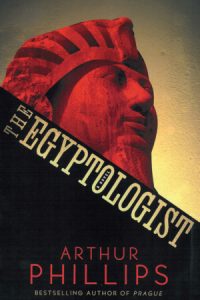
Book Group Guide
The questions that follow are intended to enhance your group’s reading and discussion of THE EGYPTOLOGIST by Arthur Phillips
For Discussion
1. Why do you think Arthur Phillips used an epistolary structure for The Egyptologist? Would it have been possible for him to structure it differently? What effect do the letters and journal entries have on the voice of the novel?
2. Early in the novel, Trilipush writes to Margaret, stating “These writings are the story of my discovery, my trouncing of doubters and selfdoubt. I am entrusting to you nothing less than my immortality…. If something should happen to my body, then you are now responsible . . . to ensure that my name and the name of Atum-hadu never perish” (5–6). What drives his obsession with immortality? Explore Ferrell’s similar preoccupation with his own lasting fame, and how this theme pervades the novel as a whole. so h-
3. What does Atum-hadu symbolize? How does Trilipush relate to him?
4. In his journal, Trilipush relays three drastically different translations of hieroglyphs written by Atum-hadu—he writes, “Clenched and trembling men like Harriman and Vassal cannot restrain themselves from spilling educated and less educated guesses over barren, tattered evidence, producing great, pregnant speculations” (90). What point is Phillips making here about history and truth?
5. Describe Trilipush and Margaret’s relationship. Are they really in love? Do they have other motives for carrying on their love affair? How does their relationship change throughout the course of the novel?
6. Explain the effect of unreliable narrators in The Egyptologist. At which points did you find yourself trusting Trilipush or Ferrell? What are each of their motives?
7. Trilipush wonders, “How did [Atum-hadu] know that his authority would endure to the last crucial minute, and that his world would then disappear a moment later, under the onslaught, before anyone who knew enough thought to disturb his peace? Somehow he did it, setting for us the most brilliant Tomb Paradox in the history of Egyptian immortality and preparing, for only the most brilliant and deserving, a discovery like no other” (160). What is the Tomb Paradox, and what significance does it have? What is its equivalent in Trilipush’s life?
8. Explore the issue of self-delusion in The Egyptologist. What have each of the characters—Trilipush, Ferrell, Margaret—deluded themselves into believing? At what point does each of them come to their definition of truth, and what effects do their versions of clarity have on them?
9. Trilipush writes, “Despite my easy childhood, the men whom I admire most in this world are self-made men, a description which seems to fit the king” (265). What does he mean by this? Has his own evolution followed that of a “self-made” man?
10. On page 267, Trilipush explores the concept of three births. Explore the significance of this cycle and how it relates to the novel.
11. Were you surprised by the ending of The Egyptologist? How does the tone of the novel change in the final scenes? How does your perception of Trilipush and what he has achieved changed?
About the Author
Arthur Phillips was born in Minneapolis and educated at Harvard. He has been a child actor, a jazz musician, a speechwriter, a dismally failed entrepreneur, and a five-time Jeopardy! champion. His first novel, PRAGUE, was a national bestseller, a New York Times Notable Book, and the recipient of the Los Angeles Times/Art Seidenbaum prize for best first novel. It has been translated into seven languages. He lives in New York with his wife and two sons.