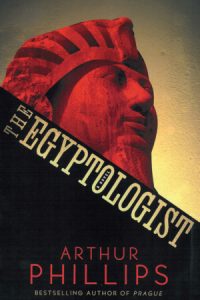
Reviews
The Herald-Sun (NC) – October 10, 2004
“Young Mr. Phillips has a second book in him after all. If anything he is even more clever and erudite than in his brilliant debut Prague – though this time around he is so obviously over the top and playful with the language you won’t mind the affectations. While the book is written with an almost cartoonish absurdity, the desperate, desperate efforts the characters go to to achieve their goal gives them a believable – though pitiful – realism… The Egyptologist slyly evokes F. Scott Fitzgerald with his take on the darker side of the roaring ’20s and his themes of reinvention, unobtainable love and deadly misunderstandings.”
— J.P. Trostle
The News & Observer (NC) – October 10, 2004
“Delirious, witty fun… Arthur Phillips’ second book, The Egyptologist is… an excellent addition to the shelf of novels about narrative self-deception. The novel is diabolically complicated in its construction. It’s told in journals, maps, book prefaces, cables, billets-doux and windy, self-justifying letters. The reader frequently gets entangled in this thicket of contradictory documents, competing versions, characters vying for attention and empathy… Phillips’ tomb-raider could easily become a mere buffoon, a figure of fun, but… Phillips makes the reader believe in and feel for him.”
— Michael Griffith
Providence Journal – September 26, 2004
“This is a dense and witty novel, full of surprises and puzzles, set in a hot, dusty landscape populated by odd characters. The Egyptologist of the title is Ralph Trilipush… His journals contain drawings and descriptions of the rooms he finds, the inscriptions and the pictured walls. He brilliantly evokes Atum-hadu’s last days, at the end of Egypt’s preeminence, with invaders taking over the whole land, and he translates the king’s pornographic verses into lucid English… Arthur Phillips’ first novel, Prague, won critical acclaim. The Egytologist may well copy that earlier success.”
— Lois Atwood
USA Today – September 16, 2004
“Dig in and enjoy… [The Egyptologist] is the perfect vehicle for Phillips to explore again the ways that nationality, background and desire influence the personalities he creates…
Trilipush’s tale is told through his expedition journal, which is part love letter to his fiancee and part chronicle of his personal agonies and desires. Trilipush is particularly plagued by the real-life Howard Carter, who is excavating the tomb of King Tut nearby.The more desperate Trilipush is to prove that Atum-hadu was an important figure, the more wildly he speculates and vacillates. These discrepancies are the basis for the funniest of Phillips’ enigmas.”
— Melanie Danburg
San Francisco Chronicle – September 12, 2004
“The Egyptologist is a wonder, a work of imaginative prowess that more than fulfills the promise of Prague. It’s ambitious. It’s inventive. It’s challenging. And it’s the kind of book that puts a writer’s career on track without his having to endure murmurings of slipping on the second try.
Phillips creates a labyrinth of a story, moving back and forth in time and place, layering uncertainty and intrigue… but he also knows how to craft a twisting, page-turning tale. Yet what’s most impressive is how Phillips conveys authenticity and authority throughout, conjuring a fictional world that seems like a nonfictional one. The Egyptologist offers stunning re-creations of the past, from the slums of pre-World War I Sydney and the post-World War I opium dens of Boston to Egypt itself… And then there’s Phillips’ inspired creation of Atum-hadu and the vivid rendering of ancient Egypt and the waning days of the XIIIth Dynasty. It’s as if Phillips is culling this information from the pages of history. But he’s not; he’s breathing life into it himself, from the fictional king’s poetry to the imagined dramas of his royal court… The true treasure of The Egyptologist is not the potential riches to be found in Atum-hadu’s tomb, but rather Phillips himself.”
— Andrew Roe
San Jose Mercury News – September 12, 2004
“The Egyptologist is… a glittery, intricate entertainment, the work of a writer uncommonly skilled at creating intelligent puzzles… It won’t take you many pages to figure out that [Trilipush] is some kind of fraud… And the neat trick is that Phillips lets Trilipush (or whoever he is) tell much of the story. But another side of the story is provided by the letters written in 1954 and 1955 by Harold Ferrell… If you’ve gathered that The Egyptologist is a kind of brainy animated cartoon in novel form, you’ve got it… But it often verges on brilliance.”
— Charles Matthews
Christian Science Monitor – September 8, 2004
“Dazzling… brilliant… scathingly funny… Should you find yourself entombed in ancient Egypt, hope that your minions included a copy of Arthur Phillips’s new novel among the gilded tools and ebony furniture. It’ll make the time fly, and it’s practically bright enough to read by its own light… Slippery truths fall out of these outrageous stories like asps from overhanging branches. Beneath all his comic ventriloquism and ribald parody of academia, Phillips is reaching for something more profound: the sad ways people represent and misrepresent themselves, shifting awkwardly from confidence to self-delusion.”
— Ron Charles
Star Tribune – September 5, 2004
“A madcap tall tale… The Egyptologist is an adventure yarn and a murder mystery in opera bouffe form. Two principal performers share narrating duties, with a supporting cast that… [is] hugely, melodramatically, gloriously deluding us, one another and themselves. This is not fiction pretending to reflect reality, but the novel as funhouse mirror – a zesty celebration of the Big Lie… A delicious pleasure of the novel is finding the clues, both subtle and broad, that Phillips plants… You’ll be left to wonder: Where in the fictional world will that swashbuckling Phillips turn up next?”
— Brigitte Frase
The San Diego Union-Tribune – September 5, 2004
“While The Egyptologist is a genuine thriller, it is also genuinely hilarious. In Phillips’ hands this makes for an outlandish and refreshing literary combo. There are real, compelling mysteries involving a bizarre legacy and possible identity theft/murder in post-WWI Egypt, all so convoluted that, at the end, what (if anything) happened, and who is (or is not) who remains gloriously unclear… Phillips (Prague) keeps upping the ante with Trilipush, pushing his audacious, egomaniacally single-minded character further and further, almost slipping into slapstick, then leaping beyond slapstick into breathtaking comic madness. And who, until Phillips, saw the comedic possibilities inherent in Egyptian cat worship?”
— Arthur Salm
Newsday – September 5, 2004
“Exhilarating… Related strictly through correspondence and diary entries, The Egyptologist is as tantalizing as the search it recounts for Atum-hadu, the Moby-Dick, Holy Grail and El Dorado of Phillips’ obliquely told tale. The very existence of Atum-hadu is questioned by all those with sense, but Trilipush is valiantly determined to find him – and the reader becomes just as determined to figure out who or what Trilipush is… Among the delights of Phillips’ accomplished, exhaustively researched novel is its subtextual fascination with perception and the often willfully blinkered aspects of human interaction.”
— John Anderson
Salon.com – September 2, 2004
“A romantic explorer searches for a Pharaoh’s tomb, while a cynical detective searches for the truth about the explorer. In this delightfully old-fashioned tale, they’re both completely misguided… To the reader goes the diverting task of sifting through the lies, delusions, evasions and misperceptions of these two men to arrive at some notion of what really happened. That makes The Egyptologist a kind of puzzle, but… the real game lies in the slow revelation of why neither man can allow himself to understand the truth and how what we need to believe about the world often becomes more important to us than our own lives.”
— Laura Miller
Esquire – September 1, 2004
“An intricately built whodunit for the King Tut lover in all of us. Phillips constructs his tale entirely from old-fashioned modes of communication-the long and expository letter, the urgent cablegram, the private journal. Two narrative lines spin out to form a rather tangled plot… This approach calls to mind the intertextual urgency of Bram Stoker’s Dracula , the darkly comic play of Nabokov’s Pale Fire… When is the last time somebody made the effort to spin you a tale? When is the last time you encountered a contemporary writer with Phillips’s far-reaching interests and easy facility with far-away places, far-away times?”
— Benjamin Alsup
People Magazine (Four Star Review, Editor’s Choice) – August 30, 2004
“A cracked, utterly engulfing detective tale [modeled] on Vladimir Nabokov’s Pale Fire, the czar of all unreliable-narrator yarns. In both novels, you don’t read between the lines; you live between them. Phillips, matching the cleverness of his debut, Prague, sends his titular digger, a hero (or fraud) named (maybe) Ralph Trilipush, to Egypt in 1922, where he is trying to unearth the treasures of Atum-hadu, a pharaoh-poet (or maybe a pornographer–who, by the way, might not have existed)… Trilipush’s Cheops-size ego is hilarious, and readers will be crazed to get to the next page—not only to find out what happens next, but to find out if what just happened really happened.”
— Kyle Smith
Chicago Sun Times – August 29, 2004
“Everybody is hiding behind something else, and nothing or nobody is what it seems in this awesomely clever fiction…. There are layers and layers to several things, particularly identities, in this novel… It remains only to say that, if all this is playful, there is a measure of seriousness behind it… The author deftly shifts back and forth among a half-dozen voices and styles. He admits in comments at the back of his book that when he set out to write it, he knew absolutely nothing about Egyptology. That makes the audacity of his creation as great as that of his protagonist’s, and the success of it even greater.”
— Roger K. Miller
Atlanta Journal Constitution – August 29, 2004
“Arthur Phillips’ heady novel The Egyptologist blends fact and fiction to extraordinary effect, but it is by no means predictable docu-fiction. Resonant and knowing, this comedy of manners and mores attests above all to an astonishing imagination. There are so many voices here, so many points of view, so many jokes and puzzles upon puzzles, all composing a layered, multi-perspective book that is literally and literarily fabulous… Follow Phillips down the chambers of his imagination as he uses the epistolary form to craft a murder mystery, accounts of academic infighting, homophobia among the lower classes and homosexuality among the upper, and barbed and vivid takes on pretension and racism. Marvel at his ability to create worlds he is far too young to know: high society in Boston and England during the Great War, low Australian society at the turn of the 20th century and Egyptian civilization of 1660-1630 B.C., complete with credible hieroglyphs and dirty poetry. Who would have thought archaeology could be so dramatic? The Egyptologist is a work of remarkable dimension, a tale as deep as it is tall.”
— Carlo Wolff
St. Louis Post-Dispatch – August 29, 2004
“Engrossing… A droll yet gripping tale told almost entirely by unreliable narrators, an astonishingly clever Nabokovian tangle of evasions and deceptions. Yet, thanks to Phillips’ daunting skill – genius, maybe – at revelation through suggestion, we can read beneath the lines to see what is really going on. The unreliability of narrators is both a theme of the book and the assumption underlying its indirect, comically misleading but ultimately effective method of transmitting information… But the main theme of The Egyptologist seems to the futility, indeed the madness, of the human struggle for immortality – whether by ancient Egyptians placing their bets on mummification and richly furnished tombs or by 20th-century Westerners hoping to make their names live forever by discovering those tombs.”
— Harper Barnes
The Miami Herald – August 29, 2004
“Vastly entertaining… a rich, fat historical romp… Competitive, monomaniacal, vain and deluded to a dangerous degree, Trilipush is a challenging central character whose combination of ego and intensity render his narration laughable yet perplexing… This clever, ambitious and artfully constructed novel operates on several levels simultaneously – as a detective story, a mystery and an adventure… [with] colorful sidebars that add even greater breadth to a story already fat with intrigue and dramatic diversions… The Egyptologist is a brave, deft, high-wire act of storytelling.”
— Elsbeth Lindner
Los Angeles Times – August 29, 2004
“[The Egyptologist] excavates deeper themes of class and immortality while further showcasing Phillips’ brainy playfulness and his fascination with pipe dreamers and grand illusions… The construct of the pornographer-king Atum-hadu, which translates as Atum-Is-Aroused, bears the mark of a deliciously devious imagination, a creative spirit worth tuning in… The Egyptologist is about taking that most creative and desperate of urges, the desire to secure one’s legacy and immortality, to the most outlandish extremes imaginable. It offers a king’s bounty of lively, sparkling conceptions and misconceptions.
— Heller McAlpin
Wall Street Journal – August 27, 2004
“Since The Egyptologist unfolds entirely in letters, a reader must constantly gauge whose word to trust and why… Trapped inside this maze of unreliable testimony is a thoughtful meditation on the untrustworthiness of the past. Why believe what antiquity tells us when the present is so often made of lies? It is a testament to Mr. Phillips’s art that The Egyptologist keeps us reading to the very end without ever answering the question.”
— John Freeman
Kirkus Review – August 1, 2004
“A secretive archaeologist’s obsession with an obscure Egyptian king uncovers several concealed histories-in Phillips’s clever, labyrinthine successor to his prizewinning debut… This is a suave, elegant novel, replete with sinuously composed sentences and delicious wordplay…Phillips’s formidable research and witty prose make this one well worth your time.”
Library Journal – July 2004
“Ralph M. Trilipush, the eponymous Egyptologist-a war hero who attended Oxford but never served in the military, with no record of his attendance at the venerable British institution? A sheltered, society heroine who drinks to oblivion and takes opium? These are but two central mysteries of this potpourri of intrigue, subterfuge, and deception concocted by Phillips… Unlike Prague, whose characters moved at a leisurely pace, this work offers, quite tongue in cheek, a tableau of action and adventure in a 1920s setting. Highly recommended for everyone in search of buried treasure.”
Booklist – June 2004
“Phillips follows up his first novel, the best-selling Prague, with an equally inventive if totally unexpected foray into ancient Egypt. The novel is artfully constructed in the form of letters and journal entries written by unreliable narrators, the primary one being erstwhile Egyptologist Ralph Trilipush… It all serves to support the novel’s shocking yet entirely credible ending and its themes of the longing for immortality and the nature of identity. Phillips proves himself once again to be a wildly creative storyteller.”
— Joanne Wilkinson
Publishers Weekly – June 30, 2004
“How was Phillips to follow up a debut as startlingly brilliant as Prague? By doing something completely different… The effect is that of a hall of mirrors. Where does fact end and imagination, illusion and wishful thinking begin? Phillips is a master manipulator, able to assume a dozen convincingly different voices at will, and his book is vastly entertaining. It’s apparent that something dire is afoot, but the reader, while apprehensive, can never quite figure out what. The ending, which cannot be revealed, is shocking and cleverly contrived.”