Reviews
Review Excerpts
The Guardian (UK) – March 25, 2006
“The first thing to be said about Prague is that its author is prodigiously gifted… The opening scene, one of many beautifully constructed set pieces… deftly encrypts the basic thematic DNA of the narrative that follows: authenticity versus invention; irony versus sincerity; nostalgia, desire, the city of Budapest itself… A cinematic visual receptiveness prevails throughout, the characters moving in a velvety cream of detail reminiscent of Nabokov in the way it spills around the tiniest minutiae… They amount to an extraordinarily vibrant picture of a city and a group of people at a moment of delicate, irreversible transition.”
— James Lasdun
Time Out UK (5 Star Review) – March 8, 2006
“Warmly nostalgic, a real pleasure for anyone who’s ever experienced the year away, whether working or studying. One character is studying nostalgia and there’s a long central section which reveals the historical streak that resurfaced with The Egyptologist. It’s also very funny indeed – how can you not fall for a book that is named after a place none of its characters have been, but where they wish they were and where they imagine the action is?”
LA Times (The Best Books Of 2002) – December 8, 2002
“Phillips’ novel has scope, historical perspective and complexity. His characters… are more strivers than drifters and more jaded and cynical than their early Parisian counterparts… They dream of glistening, beckoning Prague but remain in Budapest. In relaying the hardship suffered by his Hungarian characters, Phillips provides a pointed contrast to his disaffected Americans… The result is a substantive book that braves the clichés of expat ennui to consider such issues as sincerity, scruples and the vicissitudes of history.”
— Heller McAlpin
World & I – November 2002
“Fascinating… daring… Phillips’ rapturously praised first novel, Prague, is both an act of homage to an entrenched literary tradition and a truly contemporary work of impressive originality… Phillips skillfully varies the novel’s content, juxtaposing lengthy passages focused on various characters’ thought processes and emotional swings with several brilliantly developed set pieces… The novel offers many riches and pleasures along the way, thanks to the mastery (almost unheard-of in a beginning novelist) with which Phillips moves among the centers of action and reflection that crystallize around his major characters.”
— Bruce Allen
Christian Science Monitor – November 21, 2002
“With emotional accuracy and gymnastic irony, Phillips follows five friends through Hungary in 1990… The story moves fluidly through John’s experience in a culture that’s swirling with nostalgia, deception, and promise. Phillips holds a precarious balance, satirizing the rituals of modern culture while cradling John’s desperate search for a worthy life. The result is a sophisticated and profound debut novel – a witty, humane tale of a generation stumbling in a dim glow that could be dawn or twilight.”
The New Yorker – July 8, 2002
“[A] rich meditation on post-ideological ennui… What’s gratifying about “Prague” is that, beneath the up-to-the-minute cleverness, it’s really an old-fashioned novel of ideas – one of those books in which the plot feels like allegory and each character stands for some grand concept… And yet Phillips lavishes so much detail on his characters that they are no less textured—no less human—for being so obviously symbolic.”
— Daniel Mendelsohn
Minneapolis Star Tribune – June 23 2002
“Phillips delivers a brilliant debut novel that evokes the lives of young American expatriates in Eastern Europe while touching on some big subjects: history, politics, the experience of time, the pleasure and corruption of nostalgia… The writing is lyrical and caustic by turns, and sustains a brilliant tension between romanticism and irony. The 33-year-old author, Arthur Phillips, has achieved the worldly-wise tone and the deflating humor with an undertow of sadness that are hallmarks of the best European fiction.”
— Brigitte Frase
BookMagazine – July/August 2002
“Prague is one of the best first novels I’ve read in several years. It is also one of the most challenging, for Arthur Phillips reworks the nineteenth-century international novel, the setting-saturated, character-centered, slow-moving form practiced by Henry James… Like the old and beautiful city for which the novel is named, Prague requires and rewards leisurely exploration… Phillips promises to be a strong new American voice, and Prague is the largest-minded first novel since Mark Z. Danielewski’s audacious House of Leaves.”
— Tom LeClair
People Magazine – June 24, 2002
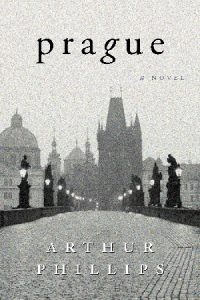
“This first novel’s withering irony starts on the front cover and seeps through every page like hot butter on a stack of pancakes. Everyone in Budapest wishes they were in Prague the way Coney Island wishes it were Disney World. Phillips makes this slacker Sun Also Rises a dark star with a swaggering style full of mischief and heckling… Few first novels blaze with such all-knowing poise. Bottom Line: Hungarian feast.”
— Kyle Smith
Salon.com – June 20, 2002
“The byways, eddies and digressions in this novel are so delectable that reading it is more like meandering through an endlessly diverting city than like charging onward toward our appointment with What Happens Next. On any given page of “Prague” you’re likely to find yourself purring with pleasure… The book does describe a particular historical wedge of humanity with a penetrating accuracy.”
— Laura Miller
Newsweek – June 17, 2002
“[Prague] not only keeps you turning pages but gives you something to think about and smile about – at the same time… Phillips has been a child actor, jazz musician, speechwriter, failed entrepreneur and five-time “Jeopardy!” champion. Now he can add accomplished novelist to his resume. And we can stop yearning for that elegant, entertaining novel that used to be. Thanks to Phillips, it’s right here, right now.”
— Malcolm Jones
New York Times – June 17 2002
“Ingenious debut novel… Mr. Phillips has an effectively oblique way of infusing the book with an awareness of history… This book does tilt toward its most easily satirized figures at the expense of its more admirable ones. But the beauty of Prague lies in Mr. Phillips’s empathy for their lapses. In the end he presents them with a wry generosity and haunting poignancy to rival his wonderfully subversive wit.”
— Janet Maslin
Kirkus Reviews – May 15, 2002
“The first half of 2002 alone can boast brilliant first novels by James Lasdun, Hari Kunzru, Ireland’s Jamie O’ Neill, and Canadian poets Steven Heighton and Michael Crummey. Good as these are, they’re surpassed by Arthur Phillips’s fiendishly clever Prague, an intricate group portrayal of five young expatriates seeking career success and (in some cases, incidentally) love in post-Communist Hungary. The ways in which their lives do and do not intersect are captured in a superb metaphor… Whether or not you’re a writer, it has probably never been a better time to be a reader.”
— Bruce Allen
Publishers Weekly (Starred Review) – April 3, 2002
“Everything about this dazzling first novel is utterly original… What happens in this novel is not nearly so important as Phillips’s wonderful grasp Budapest’s look, style and ethos, and his sometimes sympathetic, often scathing view of the Western interlopers. His writing is swift, often poetic, unerringly exact with voices and subtle details of time, place and weather. This novel is so complete a distillation of its theme and characters that it leaves a reader wondering how on earth Phillips can follow it up.”
Library Journal – March 1, 2002
“The author commands a sweep of history and a mastery of language that makes this debut highly impressive. Phillips’s exhilarating exploration of time, memory, and nostalgia brings to mind such giants as Proust and Joyce. A rich, spicy goulash served up to all with an appetite for fine writing and history.”
— Edward Cone