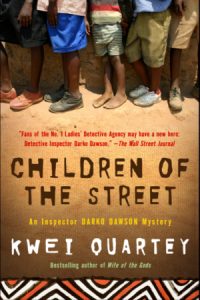
The Story Behind the Book
“Accra is a perfect place for murder,” says a character in my novel CHILDREN OF THE STREET (COTS). Fiction the work may be, but the statement is the harsh truth.
Accra is the capital of Africa’s west coast nation of Ghana, where my Darko Dawson novels are set. It’s also the place I called home up until the age of about eighteen. My African American mother and Ghanaian father were both university lecturers at the University of Ghana, where life was admittedly privileged and mostly idyllic. After my dad’s death from pancreatic cancer followed by my brush with Ghana’s military regime at the time, my mother decided we’d had enough upheaval. With my brother and me in tow, she moved back to New York, the city of her birth.
Detective Inspector Darko Dawson is with the Criminal Investigations Department (CID), a section of the Ghana Police Service. In COTS, he’s after a cunning, ruthless killer who chooses his victims from the tough, sometimes brutal world of street children. These kids, a growing social difficulty in many urban areas of Ghana and other developing countries, range from infants to teenagers. They come from rural areas, yes, but the newest generation consists of children born in the urban streets. They are there at the beginning of their lives. From a young age, they take on menial jobs like sweeping, carrying market produce or luggage, cleaning out latrines, and selling miscellaneous cheap items on the street. Waiting for some form of work to come their way, they congregate in areas of commerce, particularly open marketplaces.
I became interested in the phenomenon of Accra’s street children when I returned to Ghana in 2008 for the first time in my twenty years of being away in the States. As I was researching my first novel, WIFE OF THE GODS (WOTG), I took notice of boys and young men everywhere throughout the city doggedly pushing four-wheeled carts loaded with scrap metal and objects sometimes as large as entire car chassis and engine blocks. They’re called “truck pushers and they tend to be in their late teens to twenties. Even as I was busy finishing the final drafts of WOTG, I was thinking about a second novel with Ghana’s street children at its center. In March 2010, some nine months after the release of WOTG, I was back in Ghana to explore the world of street children in Accra, the nation’s largest city. Unlike the research for the first novel, which was more oblique in some ways, contact with these real kids was readily available. A number of non-governmental organizations (NGOs) facilitated my access to street kids, giving me the opportunity to hang out with them, interview them, and visit some of their refuges, Catholic Action for Street Children being the most prominent of these.
It wasn’t as depressing as I had expected. Children all over the world are irrepressible regardless of their living conditions. Homeless, living on less than 65 cents a day, victims of assault, robbery, and in the case of girls, rape, the Accra street kids I met were boisterous, good-humored and full of beans. Bearing testament that “child DNA” must be the same all over the world, these children are crazy about computers and video games. Where and how did they have access to these? In certain sections of Accra, you can find small kiosks with video game consoles – essentially miniature arcades. Sitting in a long row on one or two wooden benches, the kids crowd into the kiosk to rent video games in 10-minute chunks. Because cash is short, a pair or trio of boys may pool resources and share one game controller, passing it back and forth to each other.
These are the street children tourists and well-off Ghanaians alike pass by every day in air-conditioned vehicles either without a thought or with the thought that these kids are unemployed layabouts. One doesn’t feel quite that way after having met them. They become all too human, often endearing.
As you read COTS, you may wonder which of my descriptions are real. The answer is practically all of them. They are lifted directly from what I witnessed in Accra, including actual locations and street names. The street children characters are invented, but they don’t stray that far from real ones.
The murder in my novel is what is made up. Or is it? I’m not absolutely sure. Late one night in March 2010, I explored after-hours Accra. We are talking about midnight, one and two o’clock in the morning. For my safety, I went with my friend Frank, a detective lance corporal in CID who knows all the spots.
Apart from clusters of brightly lit areas such as the nightclub hubs, much of Accra is deeply, impenetrably dark and eerily still. Frank and I went on foot through the city. At one point, in a cul-de-sac along a street called Knutsford Avenue, Frank headed off a roughneck who was approaching us in a menacing manner. Often alone in my travels, I don’t think I’ve ever been so glad to have someone by my side.
I saw homeless children and adults in the hundreds sleeping on bare pavement. But there was something else much more chilling that I noticed: here and there under a bush or tucked into a dark alcove near a shuttered store or office was the odd person sleeping by him or herself away from the rest of the pack. That’s when the hair on my neck stood up and I thought, this is a perfect city for murder. It’s not just the darkness of Accra’s night. There’s one other fact that will make you understand why I had this disturbing thought. False urban legend or not, there is a prevailing belief in Ghana that if you report a murder to the police, you are likely to be arrested for the crime. Let’s imagine you’re living in Accra, and you witness a murder being committed. You call the police, right? Wrong. You’re thinking like an American. Think like a Ghanaian.
Let’s turn the tables around. Now you are a killer on the hunt in Accra. You move silently in the still of the night while the city is in slumber. Like a lion that strikes down a zebra foal straying from the herd, you can snatch a vulnerable, isolated street kid and get away with murder. Who’s going to report it? No one cares about some worthless street child from a godforsaken village.
Objection, your honor. There is one person who cares. His name is Dawson. Darko Dawson.