The Jewish Week Feature
Cynthia Ozick responds to The Jewish Week’s coverage of MY HOLOCAUST
The Jewish Week – July 6, 2007 — In Defense Of ‘My Holocaust’
Cynthia Ozick
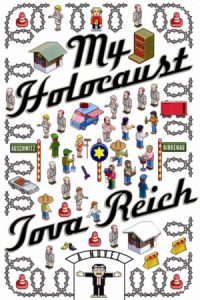
 In two successive issues, June 16 and June 27 — first in editor Gary Rosenblatt’s review (posing as a column), then in Jerome Chanes’ editorial (posing as a review) — The Jewish Week has twice undertaken to vilify “My Holocaust,” Tova Reich’s remarkable satiric novel, brilliantly conceived in wit and savage absurdity.
In a series of misapprehensions, Rosenblatt understandably, if mistakenly, concludes that I have contributed a foreword to “My Holocaust.” But a work of fiction by an established writer inevitably stands on its own, requiring no introduction by another hand. That this novel’s publisher bound a celebratory letter into the finished book was, as it happens, a production error. Nevertheless, having been peripherally implicated in The Jewish Week’s unusual double-barreled savaging, perhaps I may be permitted a response.
As Rosenblatt notes, I believe “My Holocaust” to be “a ferocious work of serious satiric genius,” a position I hold in common with the score of intelligently positive reviews that preceded The Jewish Week’s excoriations and also antedated David Margolick’s scourgings in The New York Times Book Review. I mention the latter because Rosenblatt, if not directly influenced by Margolick, concurs with him, quotes him and lauds his literary credentials as the author of a book on boxing. Yet Margolick appears cognitively to be living in a Czarist-era shtetl rather than as an equal citizen in open-voiced America when he writes that the subject matter of “My Holocaust” is “something we Jews would rather not discuss, except among ourselves.” Surely the editor of The Jewish Week, who is clearly willing to take on all Jewish issues publicly and forthrightly, can hardly wish to be linked to Margolick’s tremulous self-silencing. He does join him, though, in condemning “My Holocaust” as “embarrassing” and “loathsome,” and goes abrasively further in drawing a parallel to Norman Finkelstein’s pathological Jewish anti-Semitism.
Rosenblatt compares “My Holocaust” unfavorably to Mel Brooks’ “The Producers,” a swastika-flaunting musical that he finds inoffensive and, in fact, “hilarious.” But “The Producers” is a burlesque. “My Holocaust” is a literary satire. A burlesque is equivalent to a pratfall; it intends nothing more serious than a giggle. A literary satire is both serious and scathing; it is designed to shock, to expose, above all to clarify. Satire will not yield uplift or treacle. It will not give you the “warm, sympathetic character” Rosenblatt desires. It will give you what Swift supplies: the debased humanity of his Yahoos, sparing no one. Tova Reich chiefly targets the effects of political “diversity” leading to group rivalries, where a grasping competition for the mantle of the most egregious victimhood is paramount, and where grievance is falsely transmogrified into grief. To have missed this is to miss the whole meaning and intent of “My Holocaust.” The harsher the satire, the more powerful its moral imperatives. Satire is, in short, moral education.
But not only has the nature of literary satire been misconstrued, the nature of reviewing has itself been traduced. A reviewer is obligated to review the book in his hand, not the writer’s family connections. Jerome Chanes is astonishingly inaccurate, in matters large and small, in his characterization of Walter Reich, the Yitzhak Rabin memorial professor of international affairs, ethics and human behavior at George Washington University (not Georgetown, as Chanes has it), when he dares, outrageously, to speak of Reich’s “undistinguished tenure at the U.S. Holocaust Memorial Museum.” Undistinguished? Is this the term we should apply to Jewish moral heroism?
It was Reich, standing wholly alone, who had the necessary courage to resist administrative and political pressure to conduct the terror chieftain Yasir Arafat on a tour of the museum — a tour of the kind reserved for visiting foreign dignitaries. Nowhere does Chanes so much as mention Arafat, and I cannot believe that the author of a volume subtitled “Anti-Semitism Through the Ages” would think it appropriate for a murderer of Jews to be honored in so bitterly cynical a manner. That Chanes is motivated to obfuscate this well-known incident is incomprehensible.
Equally incomprehensible — and reprehensible? — is Chanes’ defamation of living persons by declaring “My Holocaust” a roman-à-clef. A literary sensibility, a literary intelligence, understands exactly what is meant by the novel as a work of the imagination. Yet here is Chanes asserting that the fictional Maurice Messer “is” Miles Lerman (while at the same time insisting that Tova Reich’s portrait is mistaken); and that the fictional Bunny (not Bonnie) Bacon “is” Sarah Bloomfield; and that the fictional Dr. Monty Pincus “is” Michael Berenbaum; and so on and so on. Chanes seems inclined to read fiction as one-on-one vengefulness, but whose vengefulness is it? By openly and publicly identifying these individuals with Tova Reich’s flawed characters, Chanes has shamefully besmirched an entire cohort of Jewish leaders.
As for his putative concern for survivors: “Reich’s mockery,” he claims, “extends beyond the survivors; by extension, she makes a mockery of any victimized group that makes an effort to get validation for its suffering.” But the “victimized groups” she ingeniously subverts are in the vein of the oppressed of “the Gynecological and Menstrual Holocaust,” “the Fur Holocaust,” “the Chicken Holocaust,” “The Endangered Species Holocausts” (which include “plants and animals from bluegrass to baby seals, from bladderpods to lesser long-nosed bats”), and all other copycat Holocaust wannabes who, however detestably or implausibly, insist on moral equivalence with the experience of actual survivors of the Shoah. Does Chanes not see that rather than “strik[ing] at the heart of the survivor community,” as he charges, Tova Reich is calling for a defense of the survivors’ moral integrity, and for the historical integrity of the Shoah itself?
So what exactly has happened here? A heated defender of Jewish historical clarity has been taken, in a respected Jewish journal, to be an Enemy of the People, and is paired with Norman Finkelstein. As readers, we naturally judge novels. But sometimes a novel, facing obtuseness, will mercilessly judge its readers.