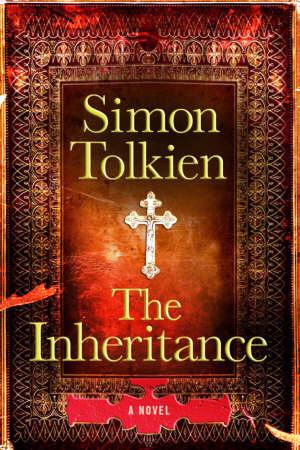
THE INHERITANCE by Simon Tolkien
I
sat down to plan my second novel, The Inheritance with the intention of
building on what I saw as the strengths of my first book, Final Witness,
while also trying to expand its thematic scope.
Both my novels are courtroom dramas as this is an area where I know the
ropes first hand from my work as a criminal barrister in London; both
have an Old Bailey murder trial as a narrative, which provides a ticking
clock against which a search for the truth plays out; and both focus on
the causes and consequences of dysfunctional relationships within a
family unit. In The Inheritance, however, I have tried to add new
ingredients. Most significantly there is a considerably wider cast of
characters than in Final Witness. This is partly because I wanted to set
a new challenge for myself and partly because I had a different
objective with this book. Final Witness describes a teenager’s quest for
justice following the death of his mother, whereas The Inheritance is
more a traditional whodunit mystery in which I have tried to keep the
reader guessing at the identity of the murderer right up until the end.
Both novel structures appeal to me but it was fun to try something new.
Final Witness turned on the inability of a father to connect with his
son but the wider cast of characters in The Inheritance enabled me to
explore other types of family relationship and in particular that
between two siblings, one of whom is adopted. I was also able to look at
different versions of evil in human beings, which is a subject that has
always interested me, and I am particularly pleased with the character
of Sergeant Ritter who combines being a cruel, cold-blooded killer with
an intense love for his commanding officer.
Another important difference between my two novels is the time setting.
Final Witness is set in the present, whereas The Inheritance takes place
in 1959, the year of my birth. I think there is an old fashioned quality
to my writing which makes the 1950s a good fit for me, but I also
switched back in time because I wanted to start exploring a historical
perspective in my writing for its own sake. History was my first love as
a child and I went on to study it at Oxford. I have always felt that the
past is not just another country but also a real place and in The
Inheritance almost all my characters are in different ways prisoners of
a past over which they have little or no control. The young man on trial
for his life believes that he is paying for the crimes of his father,
and the most important female character, Sasha is driven by the desire
to right the wrong done to her father years before. The Fifties
generation ‘never had it so good’ in the words of the British Prime
Minister of the time, Harold MacMillan, but they also lived in the
shadow of the cataclysm that was World War Two, and in The Inheritance a
terrible crime committed in a Normandy village in 1944 dominates the
lives of the characters in 1959. The investigating policeman, Inspector
Trave is also very much a man of his time, losing faith in God but
trying to do his best in a world that has spun out of control.
Setting The Inheritance at the end of the Fifties also had the practical
advantage of enabling me to incorporate the death penalty into the book
as hanging remained the prescribed punishment for certain types of
murder in the UK until its abolition in 1965. As a criminal lawyer I
have always been interested in the death penalty debate and the noose
suspended over the accused in The Inheritance certainly helped me to
raise the stakes and increase the tension.
In both Final Witness and The Inheritance I have set out to use my
imagination and my background as a criminal barrister to create
entertaining, fast-paced legal thrillers which explore how human
relationships evolve and disintegrate when placed under intense
pressure. My readers will be the judge of the extent to which I have
succeeded.
|