The Story Behind the Book
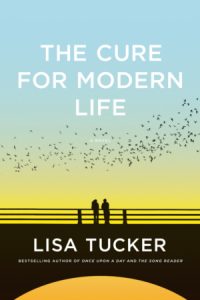
THE CURE FOR MODERN LIFE by Lisa Tucker
I was driving in Philadelphia one night when I saw a young boy, holding a small child, standing on a bridge. I slowed down long enough to realize that their mother was with them, a few steps ahead, yelling for them to hurry, but I wondered what I would have done if they really had been alone. Would I have stopped to help them? Maybe they were walking to a homeless shelter; it was a very cold night. Would I have given them a ride—or money—or something—or would I have been too afraid?
From this personal dilemma, the novel was born.
When I created Matthew Connelly, I wanted him to be the kind of person who would never help a homeless kid. I made him rich, self-involved, and deeply cynical. That he also turned out to be funny was a surprise to me. I didn’t expect to laugh as Matthew explained why you can’t trust people like Danny, the ten-year-old boy in my novel who needs help for his three-year-old sister, Isabelle. Of course Matthew turns out to be wrong about Danny, though the boy certainly does disrupt Matthew’s carefully ordered world. The relationship between the two of them is at the heart of the story, and was one of my favorite parts to write.
As the novel progressed, the central question of “Would you do the right thing?” led to other ethical questions—and other characters. Though Matthew mentions Amelia on the first page, I didn’t realize that she would be a narrator until she started talking, telling me the history of her relationship with Matthew and her reasons for disliking the man she thinks he has become in the last twelve years. Amelia detests what she sees as the “sleazy business practices” of the pharmaceutical industry and specifically of Astor-Denning, the drug company where Matthew is a VP. She chose her job writing about medical ethics the same way she has chosen everything in her life—because she wants to be a good person. Matthew thinks she is naïve. She thinks he’s corrupt. Danny thinks both of them are incredibly lucky because they have warm houses and thick coats and enough money that they never have to worry about where their next meal is coming from.
All of my books have touched on the topic of what it’s like to be poor in America, and in The Cure for Modern Life, I explore this not only through Danny and his family, but also through Matthew, who grew up poor and has been driven for the last twenty years to make something of himself. Both Matthew and his best friend Ben, a brilliant scientist, also lost their fathers at an early age, and this is another central theme in all my work: the legacy of a troubled family and specifically, what it means to be a good parent. Matthew and Ben will both have to confront the question of what becoming a father means to them, while Danny, fatherless for his entire life, has already taken on the responsibility of being the primary caregiver for his little sister. I am always fascinated by the tenacity of bonds between siblings—no doubt because my own sister has been such a central figure in my life.
The importance of place in a story is something I never lose sight of: place being more than just a setting for the action, but a determining factor in who the characters are and how they live. This is my first book set in Philadelphia, my adopted city, where I went to college and grad school, where I taught for almost a decade, and where my son was born. I love this city. It’s such a wonderfully diverse place; it’s also home to many pharmaceutical companies and some really brilliant people who work in scientific research. Like Matthew, I came here trying to make something of myself and stayed here because it felt like home.
Finally, music, which has played a role in all my novels, also plays a small but key role here, as both a means of communication and even an aid to memory. I might as well confess that, like Danny, I adore my iPod. That little device has gotten me through some very tough situations. Having music available at all times, anywhere, is truly an amazing gift.
The book is about taking responsibility, caring about others, and what it means to do the right thing—but it is also about the complexities of living in the twenty-first century, when we often feel like we can barely handle our own problems and it’s rarely clear what the right thing is, much less how to go about doing it. So is there a “cure for modern life” in this novel? All I will say is that by the end of the book, Matthew and Amelia and Danny and even Ben have figured out what they want most in life. They’ve discovered that stopping on a bridge for a stranger can lead you to make choices that you’ve forgotten you had. They’ve each learned that sometimes, the right thing is right in front of you, if only you care enough to look.
Maybe the epigraph expresses it best. The novel is peppered with quotes from children’s books, both because Danny and Isabelle are so important to the story and because children’s books have always been concerned with ethical issues like how to be a good person. The epigraph is from The Lorax, one of my son’s favorite Dr. Seuss books: UNLESS someone like you, cares a whole awful lot, nothing is going to get better. It’s not. So the “cure” is within each one of us, according to Dr. Seuss. We all have to care “a whole awful lot.” Sounds like an excellent place to start. I won’t even try to top that.