Star Tribune Feature
“There isn’t a parent on earth (I speak from experience) who hasn’t walked away from a conversation with a teenager muttering to him or herself, “Why did she say that? “Why does he think that’s a good idea,” or “Why do they act that way?” David Walsh has taken on the task of explaining in readable, sympathetic language what the recent discoveries in neuroscience have to say about our traditional frustrations with teenagers. And science has new answers which he explains beautifully! We now know better why adolescents are so impulsive at times and why they are so cranky and listless at 7:00 a.m. in the morning.
Even with new insights, however, wisdom, patience and a sense of humor are still going to be the essential tool kit for any adult working with adolescents. That is where Dr. Walsh is particularly strong. His love for adolescents shines through every page, and parents will find his generous-hearted advice both comforting and helpful.”
— Michael Thompson, co-author of Raising Cain
“David Walsh is one of the most eloquent and effective advocates for children today. This book advocates for parents as well by translating the rapidly growing research on the developing brain into an accessible guidebook for understanding the behavioral changes and emotional liquidity of the adolescent years. Any parent who reads Walsh’s compelling cases will find it much easier to understand why the once familiar dichotomy between nature and nurture is morphing into a more sensible, though sometimes complex, interplay between the two. Professionals, too, will find Walsh’s account both wise and useful.”
— W. Andrew Collins, Ph.D., Morse-Alumni Distinguished Teaching Professor; Chair, Consortium on Children, Youth, and Families, Institute of Child Development
“Down-to-earth experience together with the latest findings on brain development, this book is a wonderful resource for parents, or for that matter, anyone who interacts with adolescents.”
— John C. Nelson, MD, MPH; trustee, American Medical Association
“The adolescent brain is NOT an oxymoron! Parents and teachers need to understand its critical developmental needs, and Dr. Walsh’s clear, scientific, and humane counsel is just the ticket. I especially like his real-life stories and the chapter on helping kids manage the media.”
–Jane M. Healy, Ph.D., Educational Psychologist and author of Your Child’s Growing Mind and Failure to Connect
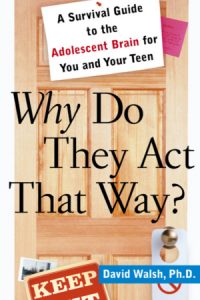
WHY DO THEY ACT THAT WAY? actually answers the question, at least as best as it can be answered. This superb book combines science, psychology, and direct experience with adolescents to create a warm-hearted, intelligent, and practical guide. Parents will find the book immensely informative, reassuring, and useful. I highly recommend it!
— Edward Hallowell, M.D., author of Driven to Distraction, The Childhood Roots of Adult Happiness, and Dare to Forgive
“Teenagers… those baffling and scary creatures your adorable kids turned into, leaving you puzzled and angry all the time. Dave Walsh’s weaving together of current understanding of the teenage brain with years of clinical experience with teens has produced a thoughtful, practical and down-to-earth guide that enables parents to understand and deal well with their teenager. If you are struggling with your adolescent, or even anticipating your child’s entrance into those crazy years, this book will show you why it all makes sense and how to help both you and your teen have the healthiest, sanest passage.”
— Gail Saltz, M.D., Assistant Professor of Psychiatry, The New York Presbyterian Hospital; Today Show Mental Health Contributor; Author of Becoming Real
“WHY DO THEY ACT THAT WAY is a comprehensive guide to the biology behind just about every adolescent behavior a parent or teacher might encounter. Drawing from his extensive clinical experience, Dr. Walsh walks the reader through many situations he has helped resolve through an understanding of how teen brains grow and develop. His gentle humor and friendly exploration of some personal parenting mishaps make this a highly readable and helpful book. You’ll finish it feeling as if you’ve just had coffee with someone who is not only entertaining and enlightening but who knows exactly how it feels to be the mom or dad of a twenty first century teen.”
— Cheryl Dellasega, Ph.D., Author of Surviving Ophelia, GirlWars (with Charisse Nixon), and Stung! Adult Women Who Are Queen Bees, Middle Bees, and Afraid-to-Bees